Skip to content

From the Deep

  • Home
    • Home
    • My account
    • Checkout
    • Portfolio
    • Shop
  • Deep Tours: Free
    • St. Louis Cathedral
    • Jackson Square
    • New Orleans Cemetery St. Louis No. 3
    • St. Anthony’s Garden
  • Blog
  • About
  • Contact
Support my research
  • Cart
  • Instagram
  • Facebook
  • YouTube
  • A Confession at the Presbytère: Museum Review

    The Presbytère Elicited My Confession after Mardi Gras and Katrina Contemplation

    I have a confession. My From the Deep research isn’t just a passion project. A visit to the Presbytère helped me realize that I had three separate catalysts and a fourth event that led to the tour guide licensure. First, my sister got married at the Court of Two Sisters a few years ago. I realized how deep and connected the history of New Orleans is while preparing. Next, my family, like so many others, discovered a secret scandal via DNA results that led to a lot of research about where the heck we came from. Finally, I lost my job in May 2023. In a massive round of layoffs, I found myself with lots of idle time and a want for a new career. I would have been celebrating my 10th anniversary this week if I were still working there.

    But before that, one leisurely day in the French Quarter, I was explaining the empty lot at 808 Royal to a friend when a group of people started forming around me. This, honestly, terrified me, and I retreated from the perceived attack. But my friend gently explained that his perception was that they were just interested in what I was saying. Interested in what I was saying? My mind cracked open.

    I have spent some of my idle time taking a professional tour guiding course and becoming licensed, some trying to decide what’s next in my career, and some visiting all of the museums in New Orleans that I somehow missed along the way. This week, I visited the Presbytère for the first time.

    Other Museum Reviews

    Musee du F. P. C.

    The Historic New Orleans Collection

    New Canal Lighthouse Museum

    Italian American Cultural Center

    World War II Museum
    Flooded House Museum

    Cabildo

    Hermann-Grima House

    Updated Aquarium

    Museum of the Southern Jewish Experience

    Gallier House

    Ogden Museum of Southern Art

    African American Museum

    Vue Orleans

    The Presbytère

    The city was already 95 years old and American before the Presbytère was complete. But the literature all cites the date they started designing, 1791, instead of the date they finished, 1813. The building gets its name, Presbytère, which means the residence of Roman Catholic priests, because Capuchin monks used the land for their homes in the early colony. This building was never a home for the religious. It was a courthouse and a commercial building.

    Now it houses part of the Louisiana State Museum, offices of the Archdiocese of New Orleans, and a police office. In addition to the Katrina exhibit, there is a Mardi Gras exhibit in the museum.

    The Katrina Exhibit

    The reason for my avoidance of this landmark was the long-running Hurricane Katrina exhibit. I have avoided most Katrina related media since the storm. I had no need to relive what I’ve already been traumatized by. Now, it’s nearly half my lifetime ago. I have started revisiting some, like Five Days at Memorial, the Flooded House Museum, and now the Presbytère.

    Is this America? The looming question after Hurricane Katrina reminds us that the unique qualities of New Orleans can lead to “othering” the people of the city.
    It’s common for folks to feel like they’ve left American soil when they visit New Orleans or even Louisiana. While we are exceptional :), this othering of the state and city is possibly what led to the question, “Is this America?” during the devastation after Hurricane Katrina.

    My avoidance of the Katrina exhibit did prove prescient. While I read as much as I could, I was sobbing before the end of the first room. Turns out, I still cannot consume media related to Katrina without having extreme emotions. That said, I recommend a visit to learn more about what happened. The museum does a great job of giving it a human face, explaining exactly what happened, and detailing what has happened since to prevent the same tragedy in the future.

    The Mardi Gras Exhibit

    The Mardi Gras exhibit has a history of balls, a history of parades, and a room on the Courir de Mardi Gras traditions of the western parts of Louisiana.

    I enjoyed learning more about the beginnings of some of the traditions. I was disappointed to see facts like “the only 19th century carnival society that still parades is Rex” without the explanation about why the other existing 19th century societies do not parade. The museum devoted equal space to the gay krewes and the Black krewes and traditions, but no mention of why the distinction of groups is necessary.

    The exhibit is a wildly sanitized and almost outdated depiction of a controversial tradition. In this video, I discuss some of the many controversies of Mardi Gras.

    • YouTube
    • Facebook
    • Instagram
    • Mardi Gras Memoirs: The Secret Parade
    • Red Light Liz and Joe the Whipper
    • Cabbage for Money, Black Eyed Peas for Luck
    • Two Odd Fellows
    • Museum Review: The Germaine Wells Mardi Gras Museum at Arnaud’s

    Lea Pearl

    • Architecture
    • Bulbancha
    • Cast Iron
    • Catholic New Orleans
    • Family History
    • Food
    • French Quarter
    • Garden District
    • Gay New Orleans
    • Ghosts of New Orleans
    • Hurricanes
    • Italian/Sicilian New Orleans
    • Le Grippe
    • Mardi Gras
    • Museum
    • New Orleans
    • New Orleans Fires
    • New Orleans Voodoo
    • Notes from the Field
    • Royal Street
    • Storyville
    • Traditions
    • United States
  • Cold Season and Remedy Recipes

    I often see little things in the newspaper archives while I’m looking for other little things. I noticed a pattern of recipes for cold remedies, so I started compiling them. My favorite recommended the following:

    “Take one wine glass of pure Brandy, Cognac or Champagne—add thereto an equal quantity of water; the whole to be swallowed at one dose. If the first proves ineffectual, the dose may be repeated every half hour until the patient feels perfectly relieved.”

    The Picayune in an 1837 article
    The Picayune. February 7, 1837. Page 2.
    The Picayune. February 25, 1837. Page 3.
    The Picayune. April 7, 1837. Page 2.
    The New Orleans Crescent. March 30, 1850. Page 4.
    The Times Democrat. July 13, 1904. Page 14.
    New Orleans Item. January 12, 1950. Page 1.

    I hope you’re staying healthy through the weather extremes. I would love to know if you try any of these remedies. I think you can trust them. After all, the first licensed pharmacist practiced in New Orleans…right?

    • YouTube
    • Facebook
    • Instagram
    • Mardi Gras Memoirs: The Secret Parade
    • Red Light Liz and Joe the Whipper
    • Cabbage for Money, Black Eyed Peas for Luck
    • Two Odd Fellows
    • Museum Review: The Germaine Wells Mardi Gras Museum at Arnaud’s

    Lea Pearl

    • Architecture
    • Bulbancha
    • Cast Iron
    • Catholic New Orleans
    • Family History
    • Food
    • French Quarter
    • Garden District
    • Gay New Orleans
    • Ghosts of New Orleans
    • Hurricanes
    • Italian/Sicilian New Orleans
    • Le Grippe
    • Mardi Gras
    • Museum
    • New Orleans
    • New Orleans Fires
    • New Orleans Voodoo
    • Notes from the Field
    • Royal Street
    • Storyville
    • Traditions
    • United States
  • Unraveling the Romeo Spikes Myth

    Go up a Romeo but come down a Juliet…?

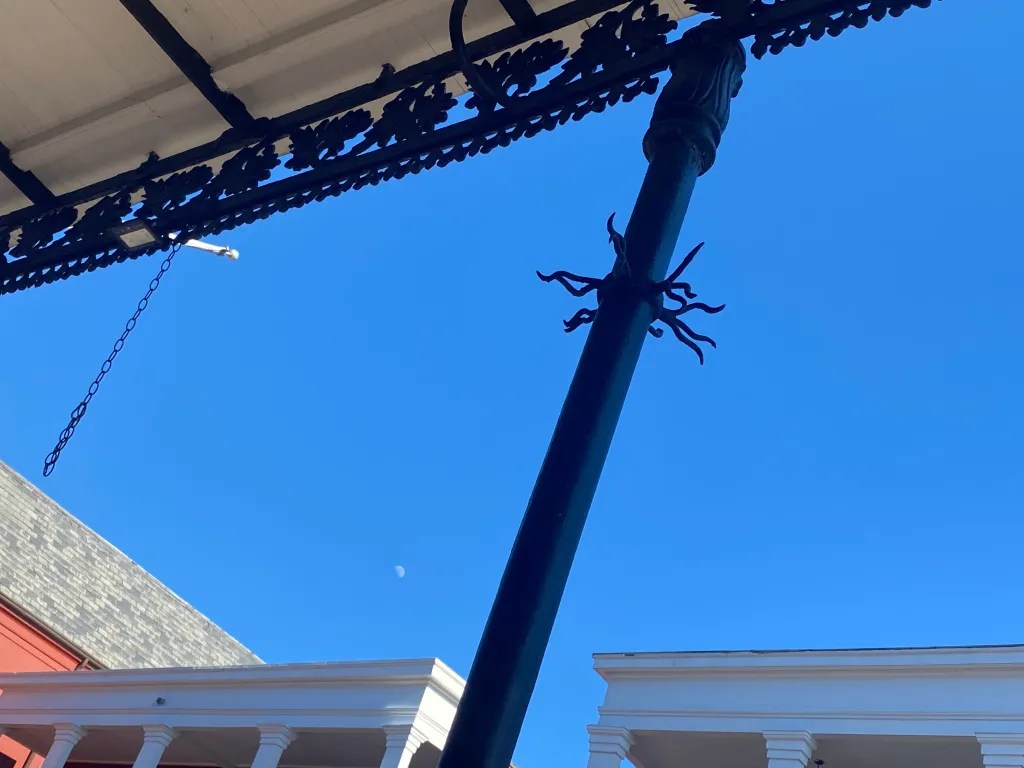
    Have you noticed this architectural oddity in the French Quarter on iron columns — the Romeo Spikes, sometimes Romeo Prongs or Romeo Catchers?

    The legend is that the vicious-looking spikes were added to the gallery columns by homeowners to keep prospective suitors away from their daughters. Some tours will continue with a ghost story about a young man who was castrated as a result of an attempt to best the spikes. So, you can tell which families had daughters by which homes have spikes. Below is a map of the spikes I’ve located in the French Quarter, but I’d love to add any others you’ve found too!

    • 700 Royal St
    • 721 Royal St
    • 736 Royal St
    • 900 Royal St
    • 1032 Royal St
    • 641 Barracks St
    • 1225 Chartres St
    • 839 Chartres St
    • 640 Bourbon St
    • 1203 Bourbon St
    • 1201 Dauphine St
    • 210 Bourbon St
    • 1031 Dauphine St
    • 740 Dauphine St
    • 500 Dauphine St
    • 425 Burgundy St
    • 811 Burgundy St
    • 1018 Royal St
    • 1014 Royal St

    While I was researching another unbelievable tale, I stumbled upon a correction of the Romeo Spikes myth claiming that the spikes are actually hostile architecture meant to keep birds away. But there is no place for a bird to nest on the posts without the spikes. Adding the spikes only seems to create a comfy place for small birds, not deter them.

    Romeo Spikes on Chartres St
    Romeo Spikes

    And making this realization while taking photos of the spikes led me to find other spikes nearby on fences. These spikes are very similar to spikes on fences in Charleston, South Carolina. I found some information about those fences: they were prototypes for barbed wire and the homeowners installed them after reports of an attempted revolt of enslaved people…

    This seems like a much more likely explanation for the Romeo spikes as well, but still I could not find anything about them outside of blogs about ghosts. I realized that the Romeo spikes were added to the columns, not a part of the original design. That led me to realize that the spikes look extremely similar to iron collars that enslavers used as punishment.

    Example of an iron collar sold at auction found online.

    Digging Deeper on Romeo Spikes

    I messaged the tour guide who was quoted to ask for a source for the information about birds, and I will update this if I hear back. I also started reaching out to knowledgable tour guides to see if they had any other information about the spikes. Eventually, I found Craig Ernst, who is a realtor in New Orleans and a volunteer tour guide with Friends of the Cabildo, one of the most respected tour guiding programs in the city. He calls himself a New Orleans history and architecture nerd. He not only responded and responded quickly, he gave me additional information!

    “I think the stories about the ‘Romeo spikes’ are just romanticized tales about what were, essentially, just another form of intruder deterrent,” he wrote.

    “Like you, I found the information about the large cheval-de-frise emplacements in Charleston. The rolls of spikes on top of some fences and gateways in the Quarter are just smaller versions of that. (Incidentally, these were originally designed as medieval protections against cavalry charges. The French translates to ‘Frisian horse’ or horseman of Frisia — a part of the Netherlands — were considered especially fierce, apparently. Similarly, the gardes-de-frise, which are the ironwork panels fashioned with different types of spikes on top and which are placed to divide balconies/galleries/verandas, or at the ends of the same, are a similar form of deterrent. I think the origin is as simple as that.”

    An example of a garde-de-frise in the French Quarter.

    He continued.

    ”Your thought about the similarity of the Romeo spikes to some of the slave collars is interesting. I’m not sure there is any direct connection (if you find out otherwise, please let me know), but it’s possible that the design of one may have inspired the design of the other.”

    Romeo Spikes on Chartres St

    I found many references in the newspapers to iron collars in advertisements for people who were wearing them when they ran away from enslavement. But I have not yet found any reference to the spikes on columns in the newspaper. I found a photo showing that at least one set of Romeo spikes was added between 1965 and 1975. But many other spikes appear in all images of the buildings available.

    Do you have any more information about the Romeo spikes and their origins? I’d love to hear from you!

    Also, check out my instagram to see more photos of Romeo spikes in the French Quarter @from_the_deep_gifts

    Addresses with Romeo spikes now and if they had daughters (in progress):

    839 Chartres [old address 217 Chartres] built in 1820s, cast iron gallery added later (sometime before 1876)

    1225 Chartres [old address 306 Chartres] built in 1830, cast iron gallery added sometime later; sold in 1833 (Manuel Julián de Lizardi who had no children1), 1849 (Canon to son, only heir2), 1858 (Canon to Pierre Hoa who had one daughter)

    700-708 Royal built in 1840; sold in 1866 from the LaBranche family who had at least one daughter who lived to adulthood3 4

    721-727 Royal built in 1840; sold to Marie de Roffignac in 1848 from her brothers; Marie had one son and one grandson5

    736 Royal built in the late 1830s by the wardens of St. Louis Cathedral; purchased by George H. Dunbar in 1880 who had several daughters with several wives6

    900 Royal built 1838 for Louis Christian Miltenberger with cast iron galleries added in 18587; Christian died in 18298 but his wife Marie Aimee died in 1858; she gave the property to her son Gustave in 18559 who had one daughter; Gustave kept the property until 1868 when it passed to his brother Aristide (one daughter) and son Charles (one son who died in Paris during World War I)10; it stayed in the Miltenberger family until 1877 when it was sold in a sheriff’s sale

    1014 Royal

    1018 Royal

    1032 Royal

    641 Barracks built in 1834; wrap around balcony is original, but the posts with Romeo spikes were added sometime between 1989 and 200711

    210 Bourbon built in 1840; had a cast iron covered gallery in the 19th century that was removed and then restored in 198112

    640 Bourbon

    1203 Bourbon

    500 Dauphine [old address 105 St. Louis] built in 1999; this was a Texaco station built in 1935 prior to the current building13; in 1896 it was a store according to the Sanborn insurance map14

    740 Dauphine [old address 108 St. Ann] building is a Creole cottage from the 19th century, but the second story was added in 192015

    1031 Dauphine [old address 253 Dauphine] built in 1840; purchased by Louis Le Carpentier in 1841 who had one daughter

    901 Governor Nicholls [old address 121 Hospital?] built in 1840; cast iron gallery added between 1876 and 1896;

    425 Burgundy built in 1840; cast iron gallery added later16

    811 Burgundy built in 1880; the gallery is original to the building but the Romeo spikes were added around 2008 based on Google Maps archived images17

    Sources:

    • Roach, Madeleine R., “Don’t Be Myth-taken: The Perpetuation of Historical Myths in New Orleans Tourism” (2021). University of New Orleans Theses and Dissertations. 2902. https://scholarworks.uno.edu/td/2902
    • “French Quarter Romeo Spikes” by Royal Tours New Orleans. October 29, 2020. https://www.royaltoursneworleans.com/french-quarter-romeo-spikes“https://www.royaltoursneworleans.com/french-quarter-romeo-spikes
    • “Walls and Fences in Antebellum Charleston” by Charleston Seen Blog. July 18, 2014. https://charlestonseen.wordpress.com/2014/07/18/walls-and-fences-in-antebellum-charleston/
    • Facebook
    • YouTube
    • Instagram
    1. Salvucci, Linda K., and Richard J. Salvucci. “The Lizardi Brothers: A Mexican Family Business and the Expansion of New Orleans, 1825-1846.” The Journal of Southern History, vol. 82, no. 4, 2016, pp. 759–88. JSTOR, http://www.jstor.org/stable/44784503. Accessed 3 July 2024. ↩︎
    2. https://www.hnoc.org/vcs/property_info.php?lot=22794 ↩︎
    3. https://www.ancestry.com/genealogy/records/jean-baptiste-labranche-24-2nc32jn ↩︎
    4. https://gw.geneanet.org/sparklynn?n=trepagnier&oc=&p=aimee ↩︎
    5. https://gw.geneanet.org/pierfit?lang=en&n=grehan&oc=0&p=paul+joseph+arthur ↩︎
    6. https://ancestors.pitard.net/getperson.php?personID=I9611&tree=1sttree ↩︎
    7. https://www.hnoc.org/vcs/property_info.php?lot=18561 ↩︎
    8. https://www.findagrave.com/memorial/157894498/louis_christian_miltenberger ↩︎
    9. https://www.hnoc.org/vcs/property_info.php?lot=18561 ↩︎
    10. https://www.findagrave.com/memorial/21233872/william_fernand_miltenberger ↩︎
    11. https://www.hnoc.org/vcs/property_info.php?lot=22824 ↩︎
    12. https://www.hnoc.org/vcs/property_info.php?lot=11329 ↩︎
    13. https://www.hnoc.org/vcs/property_info.php?lot=18709 ↩︎
    14. https://www.loc.gov/resource/g4014nm.g03376190801/?sp=1&r=0.611,0.706,0.325,0.169,0 ↩︎
    15. https://www.hnoc.org/vcs/property_info.php?lot=18772 ↩︎
    16. https://www.hnoc.org/vcs/property_info.php?lot=11567 ↩︎
    17. https://www.hnoc.org/vcs/property_info.php?lot=19081 ↩︎

    Lea Pearl

    • Architecture
    • Bulbancha
    • Cast Iron
    • Catholic New Orleans
    • Family History
    • Food
    • French Quarter
    • Garden District
    • Gay New Orleans
    • Ghosts of New Orleans
    • Hurricanes
    • Italian/Sicilian New Orleans
    • Le Grippe
    • Mardi Gras
    • Museum
    • New Orleans
    • New Orleans Fires
    • New Orleans Voodoo
    • Notes from the Field
    • Royal Street
    • Storyville
    • Traditions
    • United States
←Previous Page
1 … 13 14 15 16 17 18
Next Page→

New Orleans Deep Tours

The stories you know
with sources to show
what really happened.

lea@noladeeptours.com

  • YouTube
  • Facebook
  • Instagram

Member:
Louisiana Historical Association
LGBT+ Archives Project of Louisiana
Louisiana Notary Association

News Orleans Newsletter

Sign up to receive awesome content in your inbox, every week.

I don’t spam or sell info. You’ll get periodic newsletters with content updates, special events, and occasional discount opportunities.

You are subscribed to News Orleans Newsletter. Check your inbox or spam folder to confirm your subscription.

  • History of Sex Work in New Orleans
  • New Orleans Deep Tours
  • Posts
  • Research from the Deep: Build Your Own Custom Tour
  • Timeline
  • Blog From the Deep
  • Lagniappe (lan-yap)
  • My account
    • Cart
    • Checkout
  • Shop
  • About
  • New Orleans Deep Tours: Free
    • Free Tour: Jackson Square
    • Free Tour: St. Anthony’s Garden
    • Free Tour: St. Louis Cathedral
    • Free Tour: St. Louis Cemetery No. 3
  • Portfolio
  • Contact
  • Home

Proudly powered by WordPress

Loading Comments...