
If you only have time for one museum in New Orleans, my recommendation will always be the Historic New Orleans Collection. In the center of the French Quarter, in a historic location with a public courtyard, well-curated, free, and most importantly air conditioned, it is a necessary New Orleans experience. If you want to understand Louisiana on a deeper level, do not miss the current exhibit Captive State: Louisiana and the Making of Mass Incarceration running until January 19, 2025.
They offer a guided tour of the exhibit a few times a week. I did the tour on a Friday. My guide, Kurt, was thoughtful, calm, and engaging. Our group of five included two New Orleanians, one person from Montreal, another from Toronto via London, and a fifth who was late and didn’t introduce himself. Kurt pointed out some of the finer points the exhibit is trying to make.

The central thesis is clear: mass incarceration and slavery are linked, intrinsically. Using laws, the state constitution, and data about the prison and jail populations, the historians have painted a very clear and irrefutable picture of how we got to be the most incarcerated place on earth through regulations around leasing enslaved people for profit which evolved into leasing incarcerated people for profit. The incarcerated people in Louisiana and New Orleans are disproportionately Black; there is a higher percentage of Black people in prison or jail than make up the population. This fact isn’t just true in Louisiana as the Federal Bureau of Prisons reports that 38.8 percent of the prison population is Black while the Census Bureau reports that only 13.7 percent of the population is Black.
Enslaved people and incarcerated people have built and maintained every aspect of New Orleans since the 1700s, including levee repair, city waste and drainage, street cleaning and maintenance, pothole repair, building the Carondelet canal, and cemetery maintenance.
New Orleans is the most American city for many reasons, in my opinion, and one of them is the prominent role of the American institution of race-based slavery. Another is that Louisiana is the most incarcerated place in the most incarcerated nation. We are in a Captive State. We are the Captive State. The America we know was shaped by hundreds of years of oppression, and New Orleans sits at the epicenter of that oppression to this day. The most American city is not necessarily a good title to hold.
We look in horror on the truths of slavery in the United States from centuries ago, yet tend to look away from the horror happening in front of us now. This is largely because incarceration has been increasingly hidden from public view even as they build and maintain the infrastructure we rely on. Everyone who drove into New Orleans from the airport passed the notorious Orleans Parish Prison on the interstate. Yet, very few realize what they see.
The historians at the Historic New Orleans Collection are working to shine a bright, glaring light on the American problem of mass incarceration in Louisiana in particular, and how easily we draw a direct line from slavery to mass incarceration. The tour guide expressly stated his objective was to get more people talking about this problem in a respectful way. I hope to expand the scope of their bright light by encouraging as many people as possible to see the exhibit for yourself.


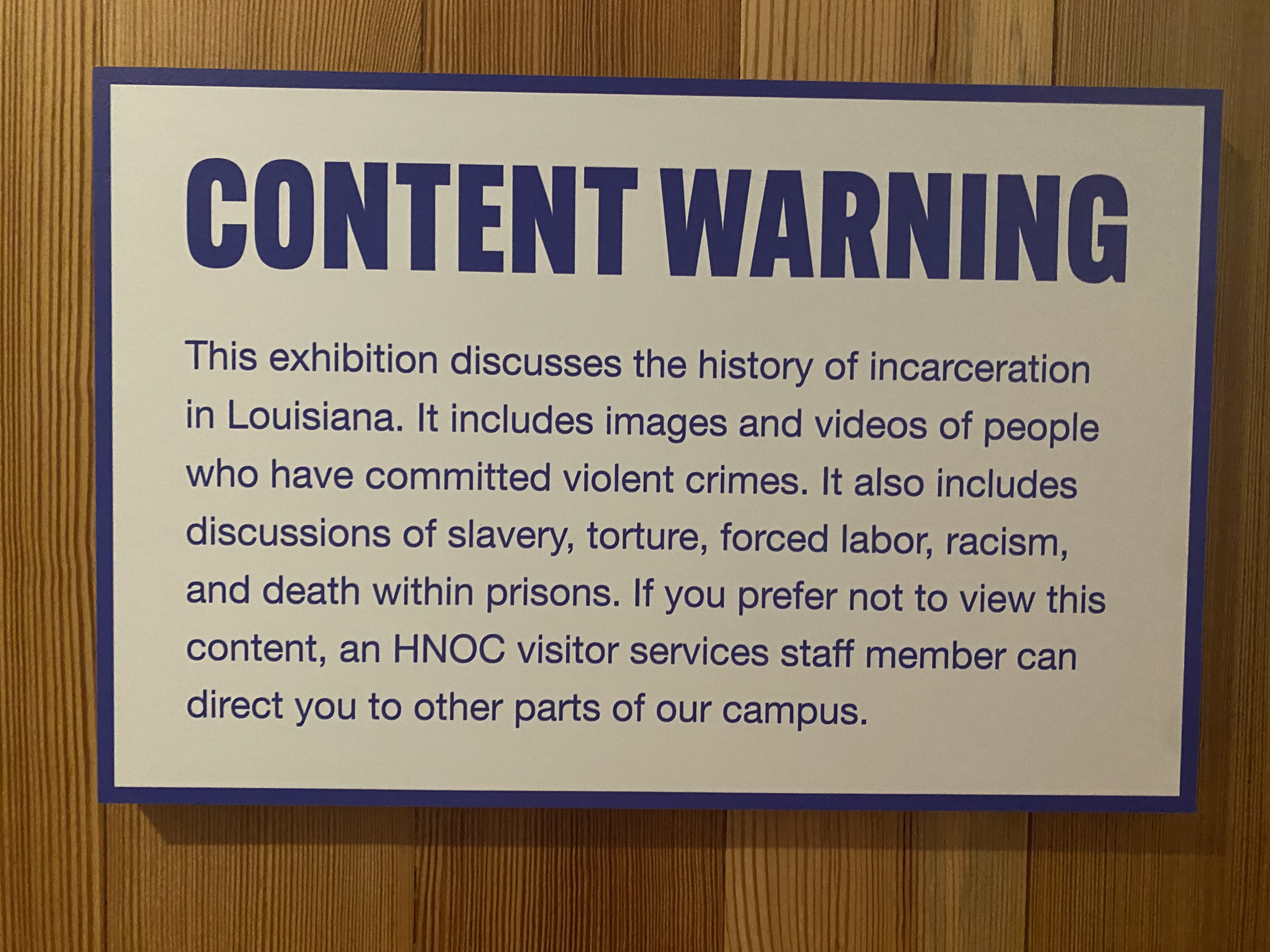
Truth in advertising alert: I had to return for a second visit about a week later to see the second floor. Here you’ll find images of people in hospice care while incarcerated. It was too much to take in at once. Every room of the exhibit includes a content warning before you begin. I hope you will take the time to see this exhibit and share what you learn with those you love.


Leave a Reply