-
Is Plaçage a Myth?

Disclaimer: This is ongoing thoughts about the plaçage myth(?) as I try to understand the history of New Orleans and not conclusive research.
I recently posted a video about the myth of plaçage. Some recent scholarly research explains that no one has found a contract regarding plaçage arrangements. We can spin rich tales about our history because so many records were kept via the Catholic Church and the notarial system, but we have no evidence of a written plaçage contract. This research concludes that the concept of plaçage, as explained by the tourism industry of today and of yore, is a myth.

Plaque outside of St. Anthony’s Garden for Henriette Delille. I can’t help but see irony in the name Place de Henriette Delille. When I started researching the life of Henriette Delille, I realized that she is thought to have been a placée before joining religious life in more recent research. The source cited for the details of plaçage, however, is the now debunked(?) older research. The life of the Venerable Henriette turns on her rejection of the plaçage system she was born into, according to her biographies. If the concept of plaçage is a debunked myth, how does the life of the Venerable Henriette change?
What we know as of now
We know that free women of color often married free men of color. We also know that they outlawed “mixed race” marriages for much of the 19th century (legalized in 1868 only to be re-criminalized in 1894 until 1972, five years after Loving v. Virginia). Further, we know that women of European descent had loving and chosen relationships with men who had African ancestors, such as Mrs. Parlongue who lived for almost a decade with Mr. Parlongue, a free person of color, only marrying officially in 1872. In the same way, women with African ancestors sometimes chose to enter relationships with men who had European ancestors, even though they could not marry. We find lots of evidence of fathers leaving inheritances to their “illegitimate” children in the records.
We know that free people of color in New Orleans enjoyed prosperous lives. Under the French, enslaved people were able to buy their freedom with the Code Noir, which they instituted in 1724 in New Orleans. But we have records of free people of color as early as 1722. We know that the first ships with enslaved people as cargo arrived in New Orleans in 1719. From the very beginning of the European takeover, people of African descent were free in New Orleans.
Free people of color are said to have enjoyed even more liberal treatment under the Spanish regime (1762-1803), whatever that means. By the time the Americans took over (1803), the relationship between people of European descent and those of African descent was souring. The Americans did not take as kindly to the three caste system as the laid back New Orleanians did. It seems that they operated as at least three “races” — those enslaved, those with any African or Native ancestry (divided further by terms to indicate which ancestor was African), and those with only European ancestry — with ever decreasing privileges for those deemed “of color”. Society never treated free people of color equally even though free people of color prospered and provided many of the inventions and much of the culture we still cherish in this city.
Another thing we know is that the Haitian Revolution pushed people to New Orleans around 1803. During this time many enslavers who were banished came to the city, along with free women of color who had fewer opportunities to prosper.
My thoughts on plaçage as of today
In a world where enslavers actively prevented some people from learning to read or write, only relying on written documentation of historic events as proof is an act of ignorance. We cannot continue to use only the documentation left by those of European descent to tell the whole story of the history of New Orleans. We cannot continue to reject rich oral histories that detail how a significant portion of the people lived.
There is an African proverb on display at the Free People of Color Museum. It was also how my teacher for two courses I’m taking now (African History of New Orleans and the History of Voodoo) chose to start. “Until the lion tells his story, the tale of the hunt will always glorify the hunter.” We’ve been denied so much truth by only telling a part of the story. We cannot learn from history until we know it all.
I do not have any conclusion. And I am not sure plaçage is a myth. My next reading assignment is Wicked Flesh: Black Women, Intimacy and Freedom in the Atlantic World by Dr. Jessica Marie Johnson. I think Dr. Johnson’s research and analysis will illuminate details of the era that I do not yet understand.
I’d also love any reading suggestions from you.
Sources:
- https://afropunk.com/2016/10/know-your-black-history-deconstructing-the-quadroon-ball/
- https://afropunk.com/2015/06/op-ed-race-forward-time-to-drop-antiquated-racial-designations/
-
A Tale of Irish in New Orleans

Museum Review: New Canal Lighthouse Museum
March is Louisiana’s Irish American Heritage Month, and my personal immigrant connection to New Orleans is through my Irish Heritage. Today, we credit Irish immigrants with making New Orleans into one of the world’s cosmopolitan cities, helping to shape the accent, and building the New Basin Canal. I always knew that some of my mom’s ancestors came from Ireland to New Orleans. I recently realized that their immigration coincided with the years of the “Potato Famine” or the “Great Hunger”.
My grandmother’s grandmother was a first generation Irish New Orleanian born in 1861. Her parents were both born in Ireland, as was her eventual husband. Her family settled in the Irish Channel. She ran a boarding house on Chippewa Street, like many other Irish women who immigrated to New Orleans and other American cities.
“Many Irish women, married and widowed, ran boarding houses as a means of support. Married Irish women could do so as well as sew on contract or help out in other kinds of family enterprise. The mother of Archbishop Williams of Boston had immigrated to the United States as a single woman and after marriage managed a boarding house while her husband worked as a blacksmith. When he died she ran both the boarding house and a grocery story in order to underwrite her son’s education. Some of the Irish boarding houses run by women also expanded into hotels and restaurants.”
Hasia R. Diner, Erin’s Daughters in America: Irish Immigrant Women in the Nineteenth Century
Early recognition that the epidemic affected strangers who were coming to town for Mardi Gras. Mardi Gras day in 1815 was February 7.
Richmond Enquirer. March 1, 1815.New Basin Canal
The mass immigration of Irish people in the mid-19th century coincided with the building of the New Basin Canal in New Orleans. “Substantial Irish communities exploded in size across the last half of the nineteenth century in San Francisco, Omaha, Memphis, New Orleans, Cleveland, Detroit, and Denver. The Irish showed up in large numbers wherever workers were needed,” Diner writes.
In the 1830s and 1840s, they hadn’t yet figured out how Yellow Fever spread. But they knew it killed many people who did not grow up in New Orleans. The nickname “The Stranger’s Disease” appeared during this era. They chose to hire Irish people to dig the canal because the cost of losing enslaved people who may die during the construction was greater than the cost of paying Irishmen to dig. They did not also lose an asset when an Irish person died. The Irish had no defenses against the tropical disease. A coinciding cholera epidemic caused the death of 8,000 or more Irish immigrants digging the canal. Ghost stories will tell you that they buried them where the fell — under the sidewalks lining Ponchartrain Boulevard today.
The Lighthouse Museum
The New Canal Museum is located in the lighthouse at the mouth of the New Basin Canal. This is the only portion of the canal that remains today. Before the mid-20th century when it was filled, the canal cut from the lake to the area near where the Superdome is today. There was a turning basin at the end. The canal made it easy to move goods into the city using the lake as a shortcut. The turning basin made it possible for large barges to turn around instead of having to back out of the canal.

Display about how many women Lighthouse Keepers served at this location. The museum is where I learned about the Victorian hinges still used all over New Orleans. There are images of the lighthouse completely destroyed during hurricanes, but the hinges remain locked in place.
This location is also unique in how many women served. A significant portion of the tour focused on these special women.
I signed up to visit the New Canal Museum through the New Orleans Public Library’s Culture Pass. There is a volunteer tour guide who is extremely knowledgeable about the lighthouse, the canal, and New Orleans. He provides a free tour. He also knew about the Irish influence on New Orleans, including pointing me to to the Celtic Cross Memorial on Pontchartrain Boulevard, which I will share in a coming post.
Irish New Orleans: Other options for learning more about the Irish influence on New Orleans
New Canal Lighthouse Museum
Celtic Cross Memorial on Pontchartrain Boulevard
Irish Cultural Museum
St. Patrick’s Church
Gallier House and Gallier Hall
Irish Channel
Irish New Orleans Trivia
James Gallier was born James Gallagher in Ireland.
Alexander O’Reilly, an Irish mercenary at the service of the Spanish crown, was the Spanish governor who murdered the Frenchmen and gave the famous street its name.

The New Orleans Revolt of 1768 in The Derby Mercury Derby Derbyshire, England April 6, 1770 Page 1 Margaret the Bread Lady was an Irish immigrant whose time in New Orleans was so impactful that a statue of her at the intersection of Prytania and Camp streets was one of the first public statues of a woman in the country.

Margaret the Bread Lady between 1890-1901 
Margaret the Bread Lady in 2024 Delphine LaLaurie was born Delphine MaCarty. Her great grandfather was a captain in the Irish regiment of Albemarle who escaped the tyranny of the English kings to France and became a knight of St. Louis. Delphine’s grandfather came to Louisiana from France in 1732.
Source:
Diner, Hasia R. Erin’s Daughters in America: Irish Immigrant Women in the Nineteenth Century. The Johns Hopkins University Press © 1983 Baltimore, Maryland.
-
Musee de F. P. C.: Museum Review


Display of prominent Free People of Color in the Museum. Free People of Color Prospered in New Orleans
Of all the museums I’ve visited recently, the Musee de F. P. C., or the Free People of Color Museum, was by far the most informative experience. In celebration of Black History Month, this is your sign to learn more about those responsible for all the things you love about New Orleans.
New Orleans had one of the largest and most prosperous communities of Free People of Color before the Civil War. The Treme is sometimes referred to as the first Black neighborhood in the United States. The neighborhood along Bayou Road and Esplanade Avenue still features prominent mansions, many of which were homes of free people of color. Black businesses have purchased many of these homes and reclaimed them in an act of resistance. The Free People of Color Museum is located in one such mansion.
The museum requires a guided tour with your admission, but it is more like a performance. My guide was an outstanding storyteller who provided historical facts, and offered emotional testimony, in character, to provide the shading facts need for perspective.
I learned more in a brief tour than all my history classes combined. From Edmund Dede and Norbert Rillieux, geniuses in their fields who eventually chose to leave New Orleans because of deteriorating conditions for people of color, to Marie Laveau and Henriette Delille, women who defied the expectations of their place in society to reign in our time as queens of their chosen vocations.
Black History playlist on YouTube Very Important Free Person of Color
Coincidentally, I was joined on my tour by four descendants of Edmund Dede. They were family, cousins, but seemed to be meeting for the first time. Two had fair complexions. They would be perceived as white people and seemingly did not know about their African heritage until recently. The two others had dark complexions. This dichotomy of family is a living representation of the myth of race. Our guide made it a point to remind the fair faction that they are Black more than once, which I took to be a welcoming gesture. It was also a very real example of how physical characteristics and ancestry do not align neatly.
The guide also pointed out several other prominent free people of color who were indistinguishable from white people during their time. The blending yielded beauty, which led to the regulations around what free women of color could wear. This included the requirement of a tignon to cover their hair. The tignon was ostensibly to provide an easy way to distinguish women of color from white women since skin color was unreliable. However, it also was an attempt to dampen their exotic beauty so that they would not tempt white men. But these were the same people who, through endless ingenuity, purchased themselves to find freedom. Many decorated themselves with the tignon so ornately that they subversively turned the hinderance into an asset. This is only one of the stories of resistance you can learn at the Musee de F. P. C.
If you have any interest in 19th century New Orleans, visit the Musee de F. C. P. There is so much more to understand. You can book tickets online.
- The French Market, Bulbancha, and Zero Waste Crafts
- Lulu White’s Obituary
- Mardi Gras Memoirs: The Secret Parade
- Red Light Liz and Joe the Whipper
- Cabbage for Money, Black Eyed Peas for Luck
-
Free New Orleans

Subscribe to continue reading
Subscribe to get access to the rest of this post and other subscriber-only content.
-
A Confession at the Presbytère: Museum Review

The Presbytère Elicited My Confession after Mardi Gras and Katrina Contemplation
I have a confession. My From the Deep research isn’t just a passion project. A visit to the Presbytère helped me realize that I had three separate catalysts and a fourth event that led to the tour guide licensure. First, my sister got married at the Court of Two Sisters a few years ago. I realized how deep and connected the history of New Orleans is while preparing. Next, my family, like so many others, discovered a secret scandal via DNA results that led to a lot of research about where the heck we came from. Finally, I lost my job in May 2023. In a massive round of layoffs, I found myself with lots of idle time and a want for a new career. I would have been celebrating my 10th anniversary this week if I were still working there.
But before that, one leisurely day in the French Quarter, I was explaining the empty lot at 808 Royal to a friend when a group of people started forming around me. This, honestly, terrified me, and I retreated from the perceived attack. But my friend gently explained that his perception was that they were just interested in what I was saying. Interested in what I was saying? My mind cracked open.
I have spent some of my idle time taking a professional tour guiding course and becoming licensed, some trying to decide what’s next in my career, and some visiting all of the museums in New Orleans that I somehow missed along the way. This week, I visited the Presbytère for the first time.
Other Museum Reviews
The Historic New Orleans Collection
Italian American Cultural Center
World War II Museum
Flooded House MuseumCabildo
Hermann-Grima House
Updated Aquarium
Museum of the Southern Jewish Experience
Gallier House
Ogden Museum of Southern Art
African American Museum
Vue Orleans
The Presbytère
The city was already 95 years old and American before the Presbytère was complete. But the literature all cites the date they started designing, 1791, instead of the date they finished, 1813. The building gets its name, Presbytère, which means the residence of Roman Catholic priests, because Capuchin monks used the land for their homes in the early colony. This building was never a home for the religious. It was a courthouse and a commercial building.
Now it houses part of the Louisiana State Museum, offices of the Archdiocese of New Orleans, and a police office. In addition to the Katrina exhibit, there is a Mardi Gras exhibit in the museum.
The Katrina Exhibit
The reason for my avoidance of this landmark was the long-running Hurricane Katrina exhibit. I have avoided most Katrina related media since the storm. I had no need to relive what I’ve already been traumatized by. Now, it’s nearly half my lifetime ago. I have started revisiting some, like Five Days at Memorial, the Flooded House Museum, and now the Presbytère.

It’s common for folks to feel like they’ve left American soil when they visit New Orleans or even Louisiana. While we are exceptional :), this othering of the state and city is possibly what led to the question, “Is this America?” during the devastation after Hurricane Katrina. My avoidance of the Katrina exhibit did prove prescient. While I read as much as I could, I was sobbing before the end of the first room. Turns out, I still cannot consume media related to Katrina without having extreme emotions. That said, I recommend a visit to learn more about what happened. The museum does a great job of giving it a human face, explaining exactly what happened, and detailing what has happened since to prevent the same tragedy in the future.
The Mardi Gras Exhibit
The Mardi Gras exhibit has a history of balls, a history of parades, and a room on the Courir de Mardi Gras traditions of the western parts of Louisiana.
I enjoyed learning more about the beginnings of some of the traditions. I was disappointed to see facts like “the only 19th century carnival society that still parades is Rex” without the explanation about why the other existing 19th century societies do not parade. The museum devoted equal space to the gay krewes and the Black krewes and traditions, but no mention of why the distinction of groups is necessary.
The exhibit is a wildly sanitized and almost outdated depiction of a controversial tradition. In this video, I discuss some of the many controversies of Mardi Gras.
- The French Market, Bulbancha, and Zero Waste Crafts
- Lulu White’s Obituary
- Mardi Gras Memoirs: The Secret Parade
- Red Light Liz and Joe the Whipper
- Cabbage for Money, Black Eyed Peas for Luck
-
Cold Season and Remedy Recipes

I often see little things in the newspaper archives while I’m looking for other little things. I noticed a pattern of recipes for cold remedies, so I started compiling them. My favorite recommended the following:
“Take one wine glass of pure Brandy, Cognac or Champagne—add thereto an equal quantity of water; the whole to be swallowed at one dose. If the first proves ineffectual, the dose may be repeated every half hour until the patient feels perfectly relieved.”
The Picayune in an 1837 article
The Picayune. February 7, 1837. Page 2. 
The Picayune. February 25, 1837. Page 3. 
The Picayune. April 7, 1837. Page 2. 
The New Orleans Crescent. March 30, 1850. Page 4. 
The Times Democrat. July 13, 1904. Page 14. 
New Orleans Item. January 12, 1950. Page 1. I hope you’re staying healthy through the weather extremes. I would love to know if you try any of these remedies. I think you can trust them. After all, the first licensed pharmacist practiced in New Orleans…right?
- The French Market, Bulbancha, and Zero Waste Crafts
- Lulu White’s Obituary
- Mardi Gras Memoirs: The Secret Parade
- Red Light Liz and Joe the Whipper
- Cabbage for Money, Black Eyed Peas for Luck
-
Unraveling the Romeo Spikes Myth

Go up a Romeo but come down a Juliet…?
Have you noticed this architectural oddity on iron columns in the French Quarter of New Orleans — the Romeo Spikes, sometimes Romeo Prongs or Romeo Catchers?
The legend is that the vicious-looking spikes were added to the gallery columns by homeowners to keep prospective suitors away from their daughters. Some tours will continue with a ghost story about a young man who was castrated as a result of an attempt to best the spikes. So, you can tell which families had daughters by which homes have spikes. Below is a map of the spikes I’ve located in the French Quarter, but I’d love to add any others you’ve found too!
While I was researching another unbelievable tale, I stumbled upon a correction of the Romeo Spikes myth claiming that the spikes are actually hostile architecture meant to keep birds away. But there is no place for a bird to nest on the posts without the spikes. Adding the spikes only seems to create a comfy place for small birds, not deter them.


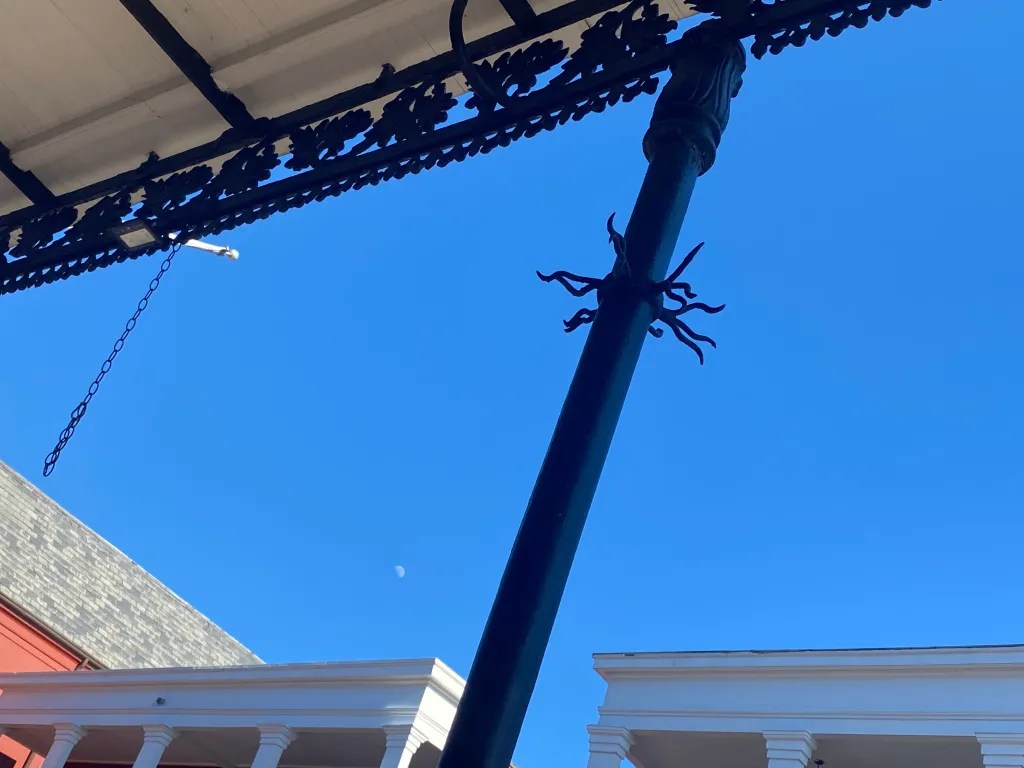

And making this realization while taking photos of the spikes led me to find other spikes nearby on fences. These spikes are very similar to spikes on fences in Charleston, South Carolina. I found some information about those fences: they were prototypes for barbed wire and the homeowners installed them after reports of an attempted revolt of enslaved people…


This seems like a much more likely explanation for the Romeo spikes as well, but still I could not find anything about them outside of blogs about ghosts. I realized that the Romeo spikes were added to the columns, not a part of the original design. That led me to realize that the spikes look extremely similar to iron collars that enslavers used as punishment.

Example of an iron collar sold at auction found online. Digging Deeper on Romeo Spikes
I messaged the tour guide who was quoted to ask for a source for the information about birds, and I will update this if I hear back. I also started reaching out to knowledgable tour guides to see if they had any other information about the spikes. Eventually, I found Craig Ernst, who is a realtor in New Orleans and a volunteer tour guide with Friends of the Cabildo, one of the most respected tour guiding programs in the city. He calls himself a New Orleans history and architecture nerd. He not only responded and responded quickly, he gave me additional information!
“I think the stories about the ‘Romeo spikes’ are just romanticized tales about what were, essentially, just another form of intruder deterrent,” he wrote.
“Like you, I found the information about the large cheval-de-frise emplacements in Charleston. The rolls of spikes on top of some fences and gateways in the Quarter are just smaller versions of that. (Incidentally, these were originally designed as medieval protections against cavalry charges. The French translates to ‘Frisian horse’ or horseman of Frisia — a part of the Netherlands — were considered especially fierce, apparently. Similarly, the gardes-de-frise, which are the ironwork panels fashioned with different types of spikes on top and which are placed to divide balconies/galleries/verandas, or at the ends of the same, are a similar form of deterrent. I think the origin is as simple as that.”

An example of a garde-de-frise in the French Quarter. He continued.
”Your thought about the similarity of the Romeo spikes to some of the slave collars is interesting. I’m not sure there is any direct connection (if you find out otherwise, please let me know), but it’s possible that the design of one may have inspired the design of the other.”
I found many references in the newspapers to iron collars in advertisements for people who were wearing them when they ran away from enslavement. But I have not yet found any reference to the spikes on columns in the newspaper. I found a photo showing that at least one set of Romeo spikes was added between 1965 and 1975. But many other spikes appear in all images of the buildings available.
Do you have any more information about the Romeo spikes and their origins? I’d love to hear from you!
Also, check out my instagram to see more photos of Romeo spikes in the French Quarter @from_the_deep_gifts
Addresses with Romeo spikes now and if they had daughters (in progress):
839 Chartres [old address 217 Chartres] built in 1820s, cast iron gallery added later (sometime before 1876)
1225 Chartres [old address 306 Chartres] built in 1830, cast iron gallery added sometime later; sold in 1833 (Manuel Julián de Lizardi who had no children1), 1849 (Canon to son, only heir2), 1858 (Canon to Pierre Hoa who had one daughter)
700-708 Royal built in 1840; sold in 1866 from the LaBranche family who had at least one daughter who lived to adulthood3 4
721-727 Royal built in 1840; sold to Marie de Roffignac in 1848 from her brothers; Marie had one son and one grandson5
736 Royal built in the late 1830s by the wardens of St. Louis Cathedral; purchased by George H. Dunbar in 1880 who had several daughters with several wives6
900 Royal built 1838 for Louis Christian Miltenberger with cast iron galleries added in 18587; Christian died in 18298 but his wife Marie Aimee died in 1858; she gave the property to her son Gustave in 18559 who had one daughter; Gustave kept the property until 1868 when it passed to his brother Aristide (one daughter) and son Charles (one son who died in Paris during World War I)10; it stayed in the Miltenberger family until 1877 when it was sold in a sheriff’s sale
1014 Royal
1018 Royal
641 Barracks built in 1834; wrap around balcony is original, but the posts with Romeo spikes were added sometime between 1989 and 200711
210 Bourbon built in 1840; had a cast iron covered gallery in the 19th century that was removed and then restored in 198112
640 Bourbon
1203 Bourbon
500 Dauphine [old address 105 St. Louis] built in 1999; this was a Texaco station built in 1935 prior to the current building13; in 1896 it was a store according to the Sanborn insurance map14
740 Dauphine [old address 108 St. Ann] building is a Creole cottage from the 19th century, but the second story was added in 192015
1031 Dauphine [old address 253 Dauphine] built in 1840; purchased by Louis Le Carpentier in 1841 who had one daughter
901 Governor Nicholls [old address 121 Hospital?] built in 1840; cast iron gallery added between 1876 and 1896;
425 Burgundy built in 1840; cast iron gallery added later16
811 Burgundy built in 1880; the gallery is original to the building but the Romeo spikes were added around 2008 based on Google Maps archived images17
Sources:
- Roach, Madeleine R., “Don’t Be Myth-taken: The Perpetuation of Historical Myths in New Orleans Tourism” (2021). University of New Orleans Theses and Dissertations. 2902. https://scholarworks.uno.edu/td/2902
- “French Quarter Romeo Spikes” by Royal Tours New Orleans. October 29, 2020. https://www.royaltoursneworleans.com/french-quarter-romeo-spikes“https://www.royaltoursneworleans.com/french-quarter-romeo-spikes
- “Walls and Fences in Antebellum Charleston” by Charleston Seen Blog. July 18, 2014. https://charlestonseen.wordpress.com/2014/07/18/walls-and-fences-in-antebellum-charleston/
- Salvucci, Linda K., and Richard J. Salvucci. “The Lizardi Brothers: A Mexican Family Business and the Expansion of New Orleans, 1825-1846.” The Journal of Southern History, vol. 82, no. 4, 2016, pp. 759–88. JSTOR, http://www.jstor.org/stable/44784503. Accessed 3 July 2024. ↩︎
- https://www.hnoc.org/vcs/property_info.php?lot=22794 ↩︎
- https://www.ancestry.com/genealogy/records/jean-baptiste-labranche-24-2nc32jn ↩︎
- https://gw.geneanet.org/sparklynn?n=trepagnier&oc=&p=aimee ↩︎
- https://gw.geneanet.org/pierfit?lang=en&n=grehan&oc=0&p=paul+joseph+arthur ↩︎
- https://ancestors.pitard.net/getperson.php?personID=I9611&tree=1sttree ↩︎
- https://www.hnoc.org/vcs/property_info.php?lot=18561 ↩︎
- https://www.findagrave.com/memorial/157894498/louis_christian_miltenberger ↩︎
- https://www.hnoc.org/vcs/property_info.php?lot=18561 ↩︎
- https://www.findagrave.com/memorial/21233872/william_fernand_miltenberger ↩︎
- https://www.hnoc.org/vcs/property_info.php?lot=22824 ↩︎
- https://www.hnoc.org/vcs/property_info.php?lot=11329 ↩︎
- https://www.hnoc.org/vcs/property_info.php?lot=18709 ↩︎
- https://www.loc.gov/resource/g4014nm.g03376190801/?sp=1&r=0.611,0.706,0.325,0.169,0 ↩︎
- https://www.hnoc.org/vcs/property_info.php?lot=18772 ↩︎
- https://www.hnoc.org/vcs/property_info.php?lot=11567 ↩︎
- https://www.hnoc.org/vcs/property_info.php?lot=19081 ↩︎
-
Fire Marks, An Unusual Adventure

A lingering detail from the 19th century
While preparing to lead my own tours, I went on a respected French Quarter tour. At the end, the guide showed us a fire mark on a building and explained that these noted which buildings had fire insurance and which company would come to help in the event of a fire. They said there were only five such markers left in the French Quarter because they had been removed and melted to make bullets during the Civil War as they were made from lead. They also promised to buy us a drink if we found the other four. But curiously did not provide any contact information to settle that bet.
Read more: Fire Marks, An Unusual Adventure
The fire mark revealed by a tour guide that started this journey. It appears in the oldest photos I can find of this building. Of course, I immediately decided to find the rest of the markers. Not for a beverage but for the knowledge. I wouldn’t let myself Google anything about it until I thought I found them all. The other day, I found a fifth mark and so I started googling. And then I found a sixth one…and a seventh and an eighth…and I keep finding them.

This mark appears for the first time in a 1988 image of the building. 
I’m not sure this is a fire mark. I haven’t been able to match it yet. Based on images available, this was added sometime between March 2022 and November 2023. 
This fire mark is visible in the oldest photos I can find of this building, so it appears to be authentic. 
This is authentic to the building based on the oldest photos I can find online. 
This mark seems to be authentic to the building. 
This mark makes its first appearance in 1987 photos of the building. 
This one appears in photos of the building from 1987 on. 
This mark was added to the building between 1992 and 1994 based on photos of the building. The other eight fire marks I found in the French Quarter. The Truth
I won’t pretend to be a fire mark expert. There are already several blogs debunking the many myths around fire marks around the world, not just in New Orleans. I’ll point you to many articles by Robert M. Shea of the Fire Mark Circle of the Americas for a full detailed history. But a brief explanation is that they originated in England around 1681 after the Great Fire of London in 1666, and there are many examples of different styles and many buildings in several countries that retain their fire marks to this day.

Comparing one of the fire marks in the French Quarter (right) to one in the collection at the National Museum of American History. According to the Museum, this is from 1875 and made of cast iron. Gift of CIGNA Museum and Art Collection. The legend is that the marks indicated the private company that the owner had paid for insurance that the company would help you in the event of a fire and other companies, if they arrived first, would let you burn. This was mostly true in England where they had private companies doing this work. Although the letting you burn part is apparently not true.

A fire mark I found in the French Quarter on the left compared to one in the National Museum of American History on the right. According to the Museum, “the Fire Association of Philadelphia issued this brass fire mark in 1859. The fire mark is painted brown, with a golden color showing underneath. The Fire Association’s fire mark consisted of a raised image of an early fire hydrant with hose attached, flanked by the letters F.A. in the center of an oval. The F.A. adopted a fireplug as their symbol to celebrate the contribution of Philadelphia’s innovative public water system to their mission of fighting fire. The Fire Association of Philadelphia was an insurance company founded in 1817 by a group of eleven volunteer engine companies and five volunteer hose companies. A percentage of the Fire Association’s insurance company’s profits were distributed to the volunteer companies. The F.A. fire mark was extremely popular, and an estimated 40,000 fire marks were issued during the company’s history. The Fire Association operated until 1958, when it merged with the Reliance Insurance Company of Philadelphia.” Gift of CIGNA Museum and Art Collection Before Fire Insurance
Fire had already destroyed many of the world’s cities, including New Orleans in 1788…and 1794, by the 19th century. They knew how destructive an unchecked fire could be and were not willing to risk letting fires burn.
According to Shea, in at least some documented instances, the fire marks represented the company who would pay the reward to the volunteer brigade who arrived at the fire first to put it out. The building’s owner had purchased insurance through the company, and some of them would guarantee rewards for the fire fighters. In the event of a fire, the first fire brigade to arrive to put out the fire would receive a cash reward for their work.
The Fire Mark and the Antique Trade
If your building didn’t retain a mark to modern times, no problem! They are readily available on eBay for $20. You can find them painted or aged and different varieties to adorn your old building. Or young building.


I also found that the one identical to the one the guide showed me on tour sold at auction recently for an attainable $90.

Comparing a mark in the French Quarter (top) to an example from Antique Trader. This mark is cast iron and sold for $90 in 2017. Courtesy of Conestoga Auction Company Division of Hess Auction Group. Note: I have noticed that one looks like it’s in relief and the other looks like it’s a cast of a relief. This is an illusion as they are both in relief. This article gives an overview of how to tell a reproduction from an authentic antique: https://www.antiquetrader.com/collectibles/real-vs-repro-how-to-spot-original-cast-iron-fire-marks Perhaps one of the most interesting bits of info I found in my search is that New Orleans Square in Disneyland includes this detail on some of the buildings. There are several blogs explaining what they are by Disney lovers.

Comparing two of the fire marks in the French Quarter (bottom) to one in the collection at the National Museum of American History. According to the Museum, this is from 1869 and made of cast iron. Gift of CIGNA Museum and Art Collection. None of the examples I’ve matched to the ones I found in the French Quarter have been made of lead so far. Several are confirmed to be from companies that existed only after the Civil War. I think it’s more likely that reasons like time and renovations have removed the fire marks, not the dramatic making of bullets for war.
This adventure was fun even if I have no way of sharing my findings with my guide beyond this blog. Perhaps I will run into them on the tour circuit soon. I am certainly glad to have any additional knowledge about the details of New Orleans.
I also want to hear your stories! Let me know if you’ve found any fire marks that I missed in New Orleans and beyond.
Now, about those Romeo spikes…
Sources
- “New Orleans Mutual Insurance Association Fire Mark” Date made: 1869. Behring Center of the National Museum of American History. Catalog Number: 2005.0233.0477. https://americanhistory.si.edu/collections/nmah_1342267
- “A Short History of Fire Marks, The World’s Hottest Insurance-Related Antiques” by Eric Grundhauser. August 29, 2017. https://www.atlasobscura.com/articles/fire-mark-collectible-insurance-crest
- “Fireman’s Insurance Company Fire Mark” Date made: ca 1875. Behring Center of the National Museum of American History. Catalog Number: 2005.0233.0473 https://americanhistory.si.edu/collections/nmah_1342356
- “American Fire Marks – A Good Story” by Robert M. Shea, CPCU. March 2014. https://firemarkcircle.org/american-fire-marks-a-good-story
- “Fire Marks: Discovering Facts Among Myth” by Robert M. Shea, CPCU. January 12, 2018. https://www.antiquetrader.com/features/fire-marks-discovering-facts-among-myth
- “Myth #146: In early America, firefighters wouldn’t put out a house fire unless the building bore a fire insurance plaque” by History Myths Debunked blog. May 13, 2017. https://historymyths.wordpress.com/tag/fire-marks/
- Fire Mark Gallery from the New York City Fire Museum. https://www.nycfiremuseum.org/fire-marks#:~:text=The%20purpose%20of%20fire%20marks,fire%20marks%20are%20collector%20items.
-
The Duels of St. Anthony’s Garden

The area behind St. Louis Cathedral has been called St. Anthony Place, Ballenger Square, St. Antoine’s Garden, and St. Anthony’s Garden, among other names, over the years. The current moniker dually honors St. Anthony with a little nod to Pere Antoine, the beloved priest of New Orleans, who made his home in the gardens during his reign over the Cathedral as its parish priest.

St. Anthony’s Garden in 2023. The area wasn’t always a fenced in private garden for the cathedral. Before the cathedral’s mid-19th century renovations, the area was larger and public.
Dr. Shannon L. Dawdy conducted an excavation in the area after it was completely destroyed during Hurricane Katrina. During her work, she found much evidence of a public market operating in this area during the colonial time. She also found many artifacts indicating that the Native Americans who lived here before the Europeans came interacted heavily with the early settlers.


A common tour tale is that public duels were often fought in the area until the priest decided they were too loud. They moved to the Dueling Oak in what is now City Park until they were outlawed entirely at the end of the 19th century.

The Dueling Oak in City Park in November 2023 There is evidence that duels were common. Many old news articles describe duels in New Orleans and around the country.

Times Picayune. January 28, 1837. Page 2. 
Times Picayune. May 4, 1842. Page 2. 
Times Picayune. January 19, 1855. Page 6. But Dr. Dawdy’s report lists no evidence of duels.
I decided to email her to ask if there was any evidence or if this is yet another tour guide perpetuated myth of 19th century New Orleans.
She was kind enough to reply.
Well, we did find a few lead musket balls and shot in the garden but since I’m convinced the space was used as a market space and campground in the 18th century, this is not at all surprising. They are ubiquitous on sites of the era. Doesn’t mean they were fired there (made of lead, they could also serve as weights for various things, or used as gaming pieces, etc., or just a random lost item from a hunter or solider). In terms of the archives, no evidence duels happened there that I’ve seen, though there are a couple of cases documented elsewhere (see The Devil’s Empire).
Dr. Shannon L. Dawdy via email to the author
It’s one of those stories that is probably half true — but we’ll never know which half.So…no duels with guns regularly held in the center of old New Orleans as far as the documentation and archaeological evidence shows. Yet another legend where the facts — the strong relationship with Native Americans in the early city and another historic public market place — are a much better story.
This story may come from the 1938 New Orleans City Guide. In it, there is a section on fencing, once the sport of choice in the city, apparently, and the duels that were held in St. Anthony’s Garden behind the Cathedral. He also references an event still occurring, the Mardi Gras Duello, an exhibition tournament between fencing clubs held on Mardi Gras day in St. Anthony’s Garden.
I found several references to this event in the newspaper, but they were all in 1937, the year the book was written. Perhaps the duels were with swords and noise was from the humans watching?
Citation: Archaeological Investigations at St. Anthony’s Garden (160R443) New Orleans, Louisiana by Shannon Lee Dawdy. University of Chicago Department of Anthropology 2011-2014.
- The French Market, Bulbancha, and Zero Waste Crafts
- Lulu White’s Obituary
- Mardi Gras Memoirs: The Secret Parade
- Red Light Liz and Joe the Whipper
- Cabbage for Money, Black Eyed Peas for Luck
-
An Image of Marie Laveau

Marie Laveau, endlessly reigning queen of voodoo, has been described by numerous sources.

The New Orleans Daily Crescent. July 12, 1859. Page 1. 
San Francisco Examiner. May 25, 1871. Page 1. 
The Daily State Journal (Alexandria, VA). April 16, 1873. Page 2. There are images thought to be her or possibly her daughter, also named Marie, but there is no confirmed image of the woman so special that more than two hundred years after her death, we still worship her memory.
(more…)