
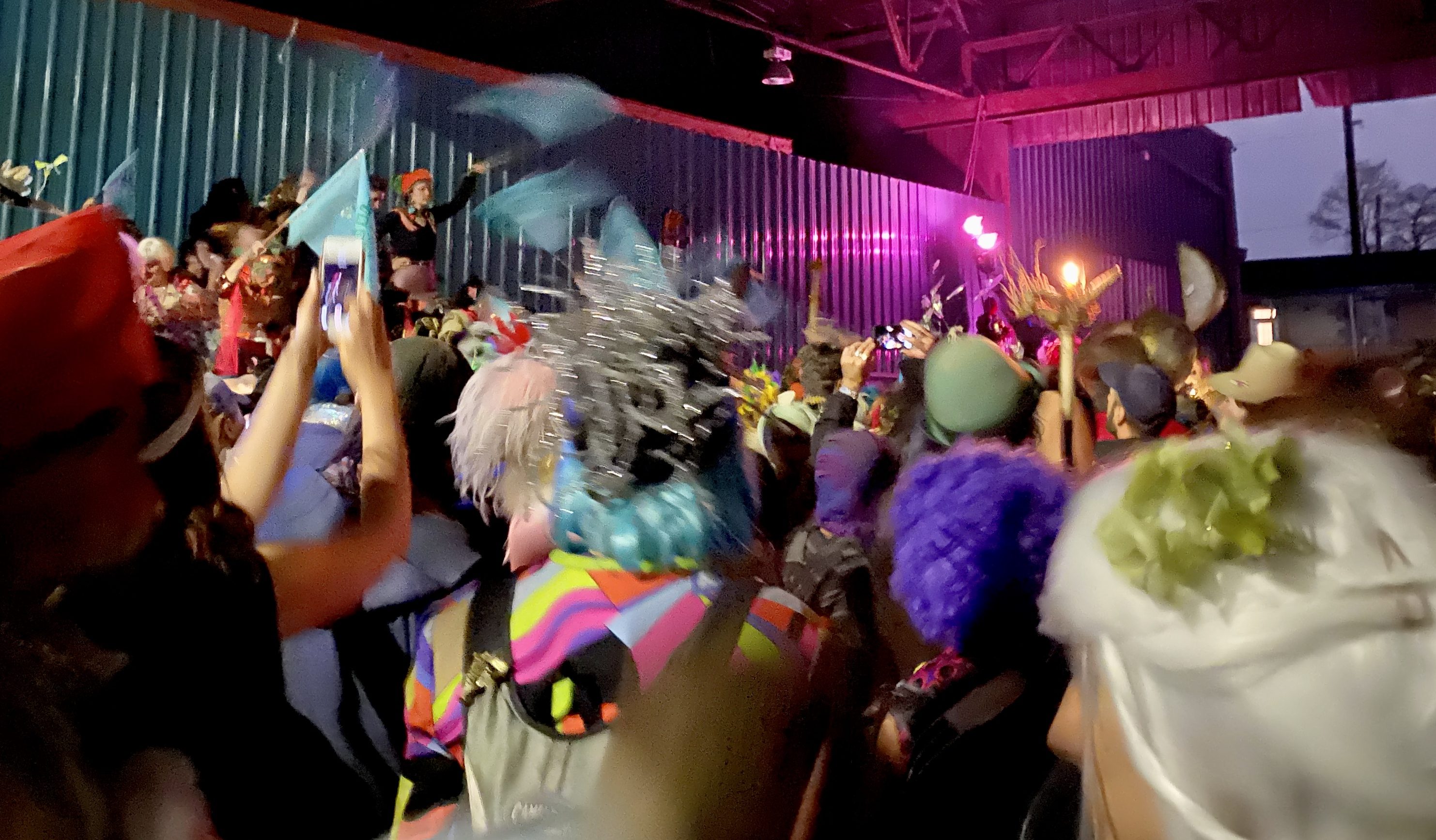
Mardi Gras has been a part of my life from the very beginning. I have always celebrated it as a spiritual holiday as I was raised Catholic in Louisiana. I have experienced Mardi Gras many different ways, including marching as a majorette in high school, going to Mardi Gras balls, and throwing ashes in the river. There is still so much Mardi Gras left to experience, but here I share my experience of a tradition that goes back to the beginning of Mardi Gras — street masquerades. May my memories give color to your perception of the spirit of Carnival.
Mirth and Discord and Fantasy
A lot of nonsense happens during Mardi Gras. Scammers descend on the city for the influx of tourists. Underground parties attract like minds. Rivers of drugs and money and liquor flow alongside the Mississippi for the two weeks leading up to Fat Tuesday.
Among the illegal activities happening around town are unauthorized, secret parades. Parades designed and executed without any city approval, planned or approved route, or prior mention that it will be happening. These parades are unadvertised. You’re lucky if you get a glimpse because they pass by your house.
Or maybe you’re lucky enough to find yourself in the orbit of the very talented artists who make Mardi Gras. They have the secret recipes for rain defying papier mâché used on floats. They have the skilled hands that sculpt paint and plaster into Bœuf Gras (the fattened calf), jesters, and the current mayor.
They become the people who extend these skills to secret and brilliant parades and parties during Carnival season. These motley krewes guard their secrets closely because they lack permits. One year, I managed to piece together clues with a friend to join one of those secret parades.
The History
The first articles that we find in the newspaper about Carnival celebrations in New Orleans are about fancy dress (or costume) balls.
Getting to the balls quickly becomes part of the custom. Parading through the streets in costumes without any planned route, sometimes in groups, became the Carnival tradition.

In the late 1830s, informal parades were organized, according to the Mardi Gras display at The Cabildo. This is, however, also when The Picayune was established, the most thoroughly archived newspaper…When something seems to appear in the late 1830s in New Orleans, I’m skeptical that this is actually when we have the first documentation of it in our newspaper archive.
The 1847 write up discusses violent occurrences including throwing flour and mud at maskers, but that the balls were quote “a redeeming and agreeable feature in the celebrations of the day” unquote.
Formal parades were first planned in 1857 with Comus, but there was no planned route. The the story goes, six men from Mobile, Alabama, invited their friends to meet at the Gem Coffeehouse on Royal Street to form the Mistick Krewe of Comus, coining the word Krewe and modern Mardi Gras secret societies. In Greek mythology, Comus, the god of festivity, is the cup bearer of Dionysus. Bacchus is another name for Dionysus, the god of wine and theater.
In 1857, they pulled off a parade with a theme of Paradise Lost. The Library of Congress has a Mardi Gras handbook printed in 1874 that explains each of the parades from the beginning until it was printed1. Comus pursued elaborate themes for their parades. They did not plan or announce the routes, so the crowds were out looking for Comus to appear.

Rex first paraded in 1872. They envisioned the new krewe as a daytime tourist spectacle. Rex was an attempt to establish order around the chaos that led to violence on previous Mardi Gras celebrations. They also decided on the traditional colors — purple for justice, gold for power and green for faith — although we didn’t get the meanings until 1892, according to Arthur Hardy2. The governor signed the Mardi Gras Act in 1872 also, making Mardi Gras a legal holiday in Louisiana.
1904 was the first mention I could find about the Zulu parade. Zulu is clearly mocking the fake royalty of the old line Mardi Gras krewes, which is a large part of the Mardi Gras tradition. Today, some of the most popular parades are satirical krewes that harshly mock the city’s leadership.

The Gathering
I knew what day but nothing else. My friend found where they were meeting using Adderall-induced focus, multiple social media platforms, and an extended network of New Orleanians. We got dressed even though we still didn’t know the theme and found exactly what we expected — hundreds of costumed revelers ready to celebrate the themed parade. The theme was not readily apparent.
A man had a cart loaded with candles shaped like hands that burned the whole parade. It was my friend’s birthday, so she pinned money to her costume, as you do. She was gifted a poster commemorating the event. She didn’t have a bag, honestly didn’t seem to care about the poster, and asked me to hold it for her. I framed it to give to her as a birthday gift. But I still have the poster.
We started somewhere under the interstate. I’m not sure where it ended and I can’t remember if that’s because we didn’t finish the parade or the location was too obscure to identify.
The next morning, my friend sent me a video she saw on Instagram of us walking in the parade. Someone who lived on the route had filmed us going by with an “only in New Orleans” type caption.
Part II
The next year I had more intel on where and when and went with another friend. We even managed to find the ball a few weeks before the parade, where I learned one of the best lessons of throwing a party.
The decorations for the event were, of course, amazing. But I was most impressed by a woman stationed at the door who greeted every guest and complimented them. She gushed sincere praise for costumes, outfits, wigs, and makeup for every single person who entered. It was the most generous good vibes, and I’ve never forgotten how she made everyone feel that night.
We knew the parade theme this time — Sports.
I dressed as a cheerleader — spandex, sparkles, and enthusiasm. Many groups had planned performances to correlate with their costumes. There was another group of cheerleaders with a whole routine, including stunts.

The most creative costume ensemble I saw was curlers who curled across the street (while the light was green and cars were waiting) with a stone made from a rotisserie chicken container. No horns were honked and much laughter ensued.
The parade ended in a neighborhood park where any sport you could imagine was played in acid-soaked extreme.
IYKYK
So many revelers will brag about riding on huge floats in the big parades, indicating that they spent thousands of dollars to reign above the crowds.
I prefer to be down on the street but still behind a mask like the original revelers, celebrating in experiences ignored by the masses and cherished by those who know. Even if it takes days to piece together clues to join the party. Because, ultimately, figuring it out, admiring the creativity, and indulging in ancient myths is part of the party.
What’s your favorite Mardi Gras memory?
Sources
- Madden, John W., Pub. Hand book of the carnival, containing Mardi-Gras, its ancient and modern observance
. New Orleans, J. W. Madden, printer, 1874. Pdf. Retrieved from the Library of Congress, <www.loc.gov/item/13018464/>. ↩︎ - Hardy, Arthur. Mardi Gras in New Orleans: An Illustrated History. ↩︎

Leave a Reply