
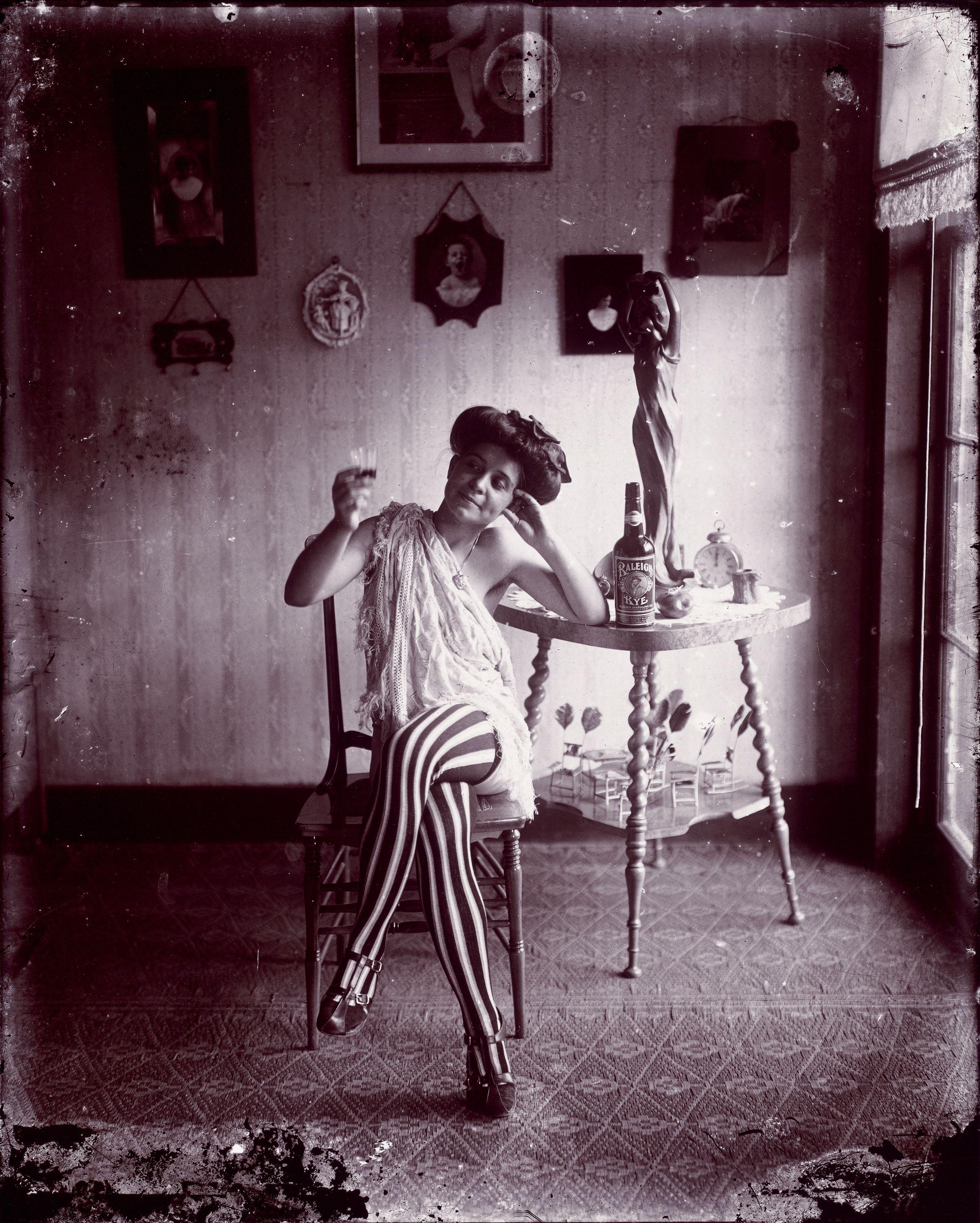
The Girl with the Striped Stockings or Raleigh Rye Girl is the most famous of E. J. Bellocq’s portraits from Storyville. The photo appears on the cover of books, in poetry, and in endless examples of life in The District. A surface analysis shows us a pleased woman in finery enjoying a drink. But E. J. includes many details for deeper analysis to give us a glimpse into The District’s truth, including that of the children.

Sometimes viewers miss the prominent bottle of whiskey with label facing forward and statue mimicking the swirling fabric draped on the woman because of her striking stockings and mischievous grin. Raleigh Rye was the favored whiskey of the time, according to some sources. Some have speculated that this was a commercial photo for Raleigh Rye.1 But descriptions almost always omit the army of feathered rocking chairs on the bottom of the table.
At first I thought these may be some sort of time keeping device, which is why they would need many of them. The only mention I’ve found of them is from a book of poetry about the portraits entitled Bellocq’s Ophelia by Natasha Trethewey. The poem is Photograph of a Bawd Drinking Raleigh Rye. The mention is fleeting with no explanation provided:
beside her: a clock, tiny feather-backed rocking chairs
poised to move with the slightest wind or breath;
This description is accurate and totally ruins any idea that these were meant to keep time. I truly can’t even describe how I thought they worked if you asked me now.
The Reality of Storyville
Upon closer look, it’s not many little rocking chairs, but a set of tiny furniture with a rocking chair most eye-catching, all decorated with feathers.

I asked Olive Camp, the operations manager at the New Orleans Storyville Museum, what she thought. Her instant reply: “I think that we often forget how young the girls in Storyville were.”
Indeed, a search for feather doll furniture from 1912 returned many more promising results, including several examples of doll furniture made out of feather quills, with feather details included.

Another photo from Bellocq’s Storyville series doesn’t feature a woman, but a series of photographs of women. Perhaps this is a display of Bellocq’s own work in one of the brothels. The photos have the women in varying levels of dress, just like Bellocq’s known portraits. Some sprawl, some pose, some are fully clothed. In one of the photos, the woman or girl holds a baby doll. The gallery items include sculptures and clocks on the cabinet with a toy mug of beer, toy horses, and a toy car on display, more evidence of the youth represented in The District.

Pretty Babies
In 1978, the movie Pretty Baby famously and controversially depicted the life of a child in Storyville2. The movie was loosely based on interviews conducted by Al Rose for his book Storyville, New Orleans, published in 1974. He interviews a “trick baby” who he named Violet.3
“I was born upstairs, like in the attic of Hilma Burt’s house on Basin Street. A lot of kids was born in that attic and in the Arlington attic and other places like that. There was a midwife used to come…for all the girls who got caught. Why do people think whores can’t have kids?” Rose quotes Violet.
She explains that life in the brothel was just what she knew her whole life.
“Nobody never stopped me from seeing my mother and the rest of the girls turn tricks. I don’t remember anytime when I didn’t know what they did, or what a man’s prick looked like. Sometimes I’d watch through them portiers like they had then, and other times I’d walk right in the room and nobody said nothing,” Rose quotes Violet.
The movie Pretty Baby opens with a scene of a child intently staring directly at the camera and the sound of a woman moaning in the background. The woman in the background is her mother having another baby. The film’s director, Louis Malle, depicts the realities of the natural result of sex work, pregnancy and children, from a child’s perspective. In the movie, Violet is always presented as a child, even when they are auctioning her off.
“I don’t know if it was a good life or a bad life. I know I got a good life now, and I know how to appreciate it. But I don’t know how I’d feel about it if I went through the whole life, you know, with pimps and dope and turning tricks till I was fifty. All my three girls is older now than I was when I quit the business, and I don’t see how they’re much better off than I was at their age. I know it’d be good if I could say how awful it was and like crime don’t pay—but to me it seems just like anything else—like a kid who’s father owns a grocery store. He helps him in the store. Well, my mother didn’t sell groceries,” Violet is quoted.
In the movie, the auction scene reminds me so directly of debutante culture.4 From the white dress to the age of the girl to the tuxedoed men clamoring for a taste, there are not many differences between how prized sex workers are treated in Pretty Baby and how young girls of society’s highest rungs are treated. They are largely the same men perpetuating that behavior.
The Children after Storyville
I think it’s interesting to note that the production of this movie required abusing a child, Brooke Shields. In 2023, Shields released a documentary on ABC called Pretty Baby: Brooke Shields. She discussed the experience in the documentary.
“Louis [Malle] talked about the subject matter…I was 11 years old…and I may have not known all of the nuance, but it was a real artistic endeavor,” Brooke Shields said in her documentary.5
She also explains that Malle wanted her to be childlike in that he didn’t explain how he wanted her to behave. He wanted her to seem like a child repeating what she’d heard adults say, not a child seductress. Although, she does pointedly recount how Malle got mad at her when she scrunched her face, like a child, at kissing an adult man for her first kiss. Shields explains that she got through it because the adult man, Keith Carradine, gently told her that this kiss was pretend and didn’t count as her first kiss.
I only recently decided to watch Pretty Baby as I’ve avoided it due to the controversy. I found it hard to watch for several reasons — the overt racism and the obvious youth of an 11 year old star to start. However, I did not find that Malle intended the movie to be sexy at all. I always found the perspective as that of a child. Even when she marries an adult man, he buys her a baby doll and tells her she’s a child. I think Malle wanted to tell a story about life in Storyville for a forgotten group of people who had their childhoods erased. However, there’s no doubt that to do it he abused another child and was partially responsible for the erasure of her childhood, too.
Storyville Excavation

In 1999, a tour guide was the catalyst for an archaeological dig of a portion of Bienville Street. The site was right in the thick of The District, more than 80 years after it closed and about 50 since it was demolished. Robert Florence was convinced that work to install new sewer lines resulted in unearthing forgotten graves from the original footprint of St. Louis Cemetery No. 1, and he was determined to preserve the history. While no bones were discovered once the archaeologists were called in, they did find more evidence of children in Storyville.
”Perhaps the most surprising finds are pieces of children’s dolls and toy tea cups. Two small metal wheels may have been a toy carriage. Romanticized accounts of the district largely omit children, but they must have been an important presence in the daily life of Storyville…It’s impossible to look at the toys without wondering about the difficulties of rearing a child in a red-light district.” p. 296
Earlier the article points out that Louis Armstrong (1901-1971) was also in The District as a child delivering coal and soaking up jazz. Maybe it wasn’t the children posing as women who were playing with the toys. They wanted to be perceived as adults. The furniture set is on the bottom shelf and is ignored by the photo’s subject, within reach but out of the way. Perhaps it was the children born of the situation for whom toys were needed.
Storyville Census Data
What can we learn about how children lived in Storyville from the census data? The 1910 census was taken right in the height of Storyville. The map below is the approximate locations of homes where the census taker stopped (in progress). Starred residences were noted as homes of Black people. The diamonds are Asian residents and the teardrops are white. Hearts show where people of multiple races were listed. The markers in purple show where children under 18 are listed in the census. Since all of these homes have been demolished, these addresses are very approximate.
Not only can you see how scattered children were throughout The District, but you can see how every race was represented on nearly every block also. The District was all about segregating prostitution away from “polite” society, but it refused racial segregation within its bounds in many ways. Historians and tour guides often remember the Treme, the neighborhood where Storyville was located, as the first Black neighborhood in the United States. But this isn’t really true. The Treme was always an area with people of diverse backgrounds, a mixed neighborhood, including through the Storyville era.
I have three more installments of my Storyville video series to complete. The final episode is about Willie Piazza who famously won an early segregation battle, after Storyville was officially disbanded.
Conclusion
Raleigh Rye Girl provides some valuable and interesting insights into life in Storyville. The architecture and decor are distinct to the time. The threadbare rug and makeshift dress indicate frequent use. The clock is featured in several of Bellocq’s portraits. He also favored the necklace she wears. The booze that drenched The District, making the real money for the proprietors, is a focal point. These details along with the paraphernalia of youth are all accurate background dressings for the time. The ghostly toys point to the subtle prominence of children and maybe even the immaturity of the “women” working.
Sources
- Waguespack, Christian. “Posh and Tawdry: Inventing and Rethinking E.J. Bellocq’s Storyville Portraits,” September 29, 2017. https://medium.com/exposure-magazine/posh-and-tawdry-inventing-and-rethinking-e-j-bellocqs-storyville-portraits-b47b24042d03 ↩︎
- Pretty Baby. Directed by Louis Malle, performances by Brooke Shields and Susan Sarandon, Paramount, 1978. ↩︎
- Rose, Al. Storyville, New Orleans: Being an Authentic, Illustrated Account of the Notorious Red-Light District, University of Alabama Press, Tuscaloosa, AL © 1974. ↩︎
- “Hilda Burt’s House and Pretty Baby’s Historical Context,” November 25, 2024, https://nolaguide.wordpress.com/2024/11/25/hilma-burts-house-and-pretty-babys-historical-context/ ↩︎
- “Pretty Baby: Brooke Shields” ABC News Docuseries, March 2023. ↩︎
- Powell, Eric A. “TALES FROM Storyville.” Archaeology, vol. 55, no. 6, 2002, pp. 26–31. JSTOR, http://www.jstor.org/stable/41779085. Accessed 21 June 2025. ↩︎

Leave a Reply