
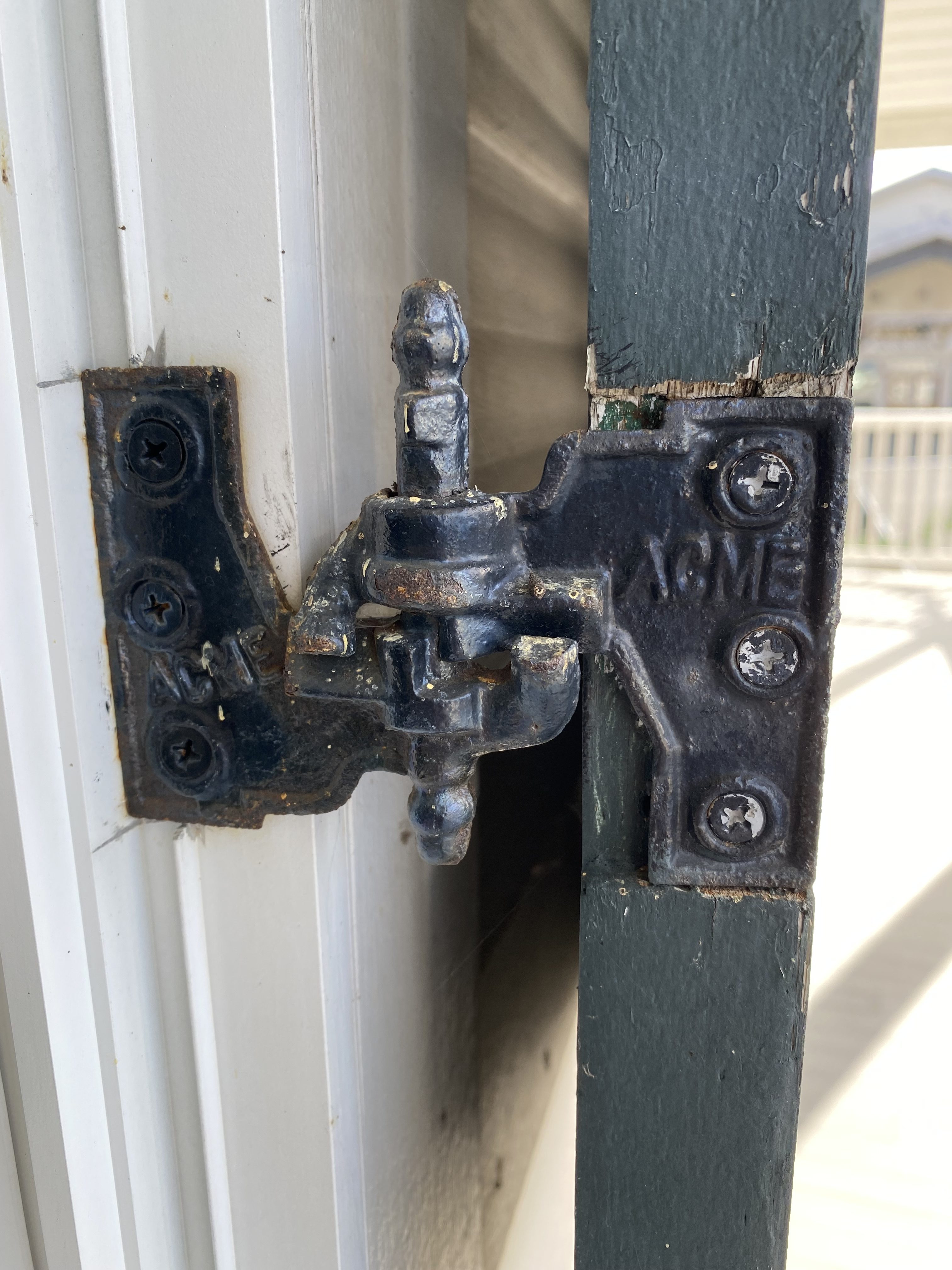
When you’re seeking your next deep New Orleans experience, look for the cast iron Victorian hinges. You can still find them on shutters on every block of the French Quarter and in many neighborhoods beyond.1 I learned about these special historic details at the New Canal Museum tour in the Lighthouse.
Note: This is part of my series on atypical things to do in New Orleans, the deep experiences. Click the button to see the rest!
The design allows one to open or close the shutters and lock them in place without tools. You lift the shutter up and then replace it to change its position. These cast iron hinges are so functional in their purpose that there are images of the Lighthouse blown completely over from Hurricane Katrina, but the shutters remain locked in place.

Listings for the hinges often include a history explaining that Harvey Lull invented them in 1854. They are referred to as the Lull and Porter Hinges sometimes and commonly the Acme Lull and Porter, or ALP, hinges today.
But the image on the patent for these hinges is similar but clearly not the same. Indeed, a repeated complaint about the 1854 design was that they did not stay closed in wind.


Many designs for hinges appear in the patent records as improvements on the Lull and Porter hinge design. The design that seems most similar to the hinges you can still find in New Orleans to my inexperienced eyes is the 1867 design by Pascal Child.


Lull filed and received extensions for his patent in 1867 and 1876. He claimed poverty. By 1874, he earned only $14,500 — about $427,768.97 in 2024 money or $21,388.40 for each of the 20 years of his patent. Others agreed that his invention should have been worth a lot more, as it was now in common use.
“No opposition to the extension has appeared, but, on the other hand, some eighty prominent hardware dealers and manufacturers (not interested in the patent) residing in the cities of New York, Hoboken, Philadelphia, Reading, Pittsburgh, Cincinnati, Baltimore, Washington, &c, have petitioned Congress for its extension, on the grounds that the invention is of great value to the public; that the said Lull has not received adequate compensation; that the public will be better protected by the extension, in having good and substantial castings made; and that the cost to the public will not be increased,” William Windom wrote in a report submitted to the 44th Congress on March 20, 1876.2
This wasn’t exactly true. Two years before, in 1874, the report issued by the Committee on Patents did not recommend extending the patent. Henry B. Sayler outlines how much Lull has made from his invention and ends with, “It is but reasonable to conclude that this sum would have been substantially increased had it not been for certain sales of interests in said inventions which were unfortunate in failing to bring to the applicant any returns whatever. No considerable time or money by the applicant in perfecting his invention is shown. Your committee are of the opinion that the equities in this case are not of such a character as to entitle the applicant the relief asked for, and would therefore report adversely thereto.”3
Nevertheless, Congress granted his extension in 1876 for seven additional years.
Patent Case
In 1882, the year before his second extension ended, Harvey Lull sued Charles Clark and several others for patent infringement.45 His claim was that the other hinges were not substantially different than his original invention, which was the mechanism by which the shutters closed and locked and not the specific pieces constructed. The invention was the mechanism, and the court agreed. “Where the mechanism used by defendant’s shutter hinge is a mere formal variation from that of plaintiffs’ invention, having the same mode of operation, it is an infringement of the patent,” the Federal Reporter concluded in 1882.
However, Clark appealed to the Northern District of New York in 1884. The decision resulted in a precedential ruling.6 The defendants objected to the initial ruling because the court found that none of the similar hinges except the Clark hinge were similar enough to infringe on Lull’s patent. They argued that this was an uneven application done without any authority of the court. In other words, the judge couldn’t have been expert in hinges enough to know that the only similar one was the Clark hinge. The court said that it was done to the best of his ability and without substantial confusion or delays. “It would create intolerable delays and confusion, besides putting an unnecessary burden upon the court to hold, that each time the master makes a ruling, the aggrieved party may, by special motion, have it reviewed,” J. Coxe wrote in his decision to deny the motion.
I found at least one case that cites Lull v. Clark (1884). In Pathe Laboratories, Inc. v. Du Pont Film Mfg. Corporation, 3 F.R.D. 11 (S.D.N.Y. 1943), the “motion to quash subpoena duces tecum issued under Rule 45 to produce records before a hearing master authorized to determine the issue of plaintiff’s damages” was denied, and the Lull decision of maintaining the authority of the court to determine what was relevant evidence was cited as a precedent.7
Lull v. Clark is also cited in Modern Pleading and Practice in Equity in the Federal and State Courts of the United States, with Particular Reference to the Federal Practice, including Numerous Forms and Precedents Volume II by Charles Fisk Beach, Jr. from 1900.8
Conclusion
In 1874, Harvey Lull had spent $1,500 on litigation, or about $40,000 in 2024. However, he hadn’t made any substantial improvements on his invention, either via time or money. He invented another totally different hinge in 1874 for blinds.9 He also had patents in 1837 (Improvement in machines for breaking and dressing hemp and flax), 1856 (Improvement in feathering paddle wheels), 1871 (Improvement in auxiliary springs for treadles), 1871 (Improvement in shade racks), and 1873 (Improvement in curtain cord fasteners). I didn’t find any indications that he sued anyone over those inventions.
Perhaps he was right to fight so hard to protect his intellectual property at the time. We are still using a variety of it today, 170 years later. I found a comment on an article explaining that the Acme version of the hinges was patented in 1906. I have struggled to find this patent. Please let me know if you know where to find it!
Timeline
1854: H. Lull Shutter Hinge
1867: Improvement in Hinges for Window Shutters
1867: Lull filed first patent extension
1874: Lock Hinges
1874: Design for Blind Hinges
1874: Patent No. 156,277 to Charles B. Clark October 27, 1874
1874: Lull filed second patent extension
1882: Lull v. Clark and others
1906: ACME Lull and Porter hinge patented
Sources
- House of Antique Hardware “Acme” Cast Iron Mortise Shutter Hinges – 3 3/4” x 2 1/2” https://www.houseofantiquehardware.com/shutter-hardware-3-3-4-inch-acme-mortise-hinges ↩︎
- Windom, William. Report No. 160 to Senate, 44th Congress, 1st Session, March 20, 1876. ↩︎
- Sayler, Henry B. (Committee on Patents), Report No. 601 to the House of Representatives, 43rd Congress, 1st Session, May 22, 1874. ↩︎
- Lull v. Clark patent and case info, https://oldhouseguy.com/images/shutters/HingePatentInfo.pdf ↩︎
- “Lull v. Clark and others,” Circuit Court, N. D. New York 1882, Federal Reporter, p. 456. https://law.resource.org/pub/us/case/reporter/F/0013/0013.f1.0456.pdf ↩︎
- Lull v. Clark, Court Listener, 20 F. 454, 22 Blatchf. 207, 1884 U.S. App. LEXIS 2233, https://www.courtlistener.com/opinion/8162499/lull-v-clark/ ↩︎
- PATHE LABORATORIES, Inc., v. DU PONT FILM MFG. CORPORATION, Case Text, Pathe Laboratories, Inc. v. Du Pont Film Mfg. Corporation, 3 F.R.D. 11 (S.D.N.Y. 1943), https://casetext.com/case/pathe-laboratories-inc-v-du-pont-film-mfg-corporation ↩︎
- Beach, Jr. Charles Fisk. Modern Pleading and Practice in Equity in the Federal and State Courts of the United States, with Particular Reference to the Federal Practice, including Numerous Forms and Precedents Volume II, W. H. Anderson and Co., Cincinnati, OH. © 1900, p. 681. ↩︎
- H. Lull Patent for Lock-Hinges for Blinds No. 148,315, March 10, 1874, https://patentimages.storage.googleapis.com/1b/39/c0/982aa30904e5da/US148315.pdf ↩︎


Leave a Reply