I recently completed a continuing education course on the History of New Orleans Voodoo at Loyola University. I wanted to spend dedicated time learning more about the African American religion that New Orleans has exported around the world in a scholarly setting.
One thing is clear from the depictions of Voodoo or Voudou or Vodou or Vauxdaux in the newspapers: there are no unbiased accounts. The reports were written by white men with all of the lenses of distortion afforded to the privileged class. One of the most remembered depictions of Voodoo comes from Lafcadio Hearn, who was not from New Orleans but spent about a decade (1877-1888) writing in the city. He is sometimes credited with “inventing” New Orleans because his stories are the ones still often retold.


But Lafcadio got a lot wrong in his interpretation of Voodoo. For instance, he explains, “…the devil is god, and it is to him they pray.” The association of Voodoo with evil is so ingrained to this day that travelers to New Orleans are stunned to learn that Voodoo is a real religion. In fact, there is no devil in the Voodoo tradition, according to all of the speakers in my class and all sources I’ve referenced. In his article “The Secret and Irreligious Doctrines of Voodooism” from the Journal of Church and State, Dr. Kodi Roberts explains, “Hearn frequently focused readers on the supposed foreignness and backwardness of Voodoo while simultaneously using it to characterize and exoticize New Orleans. Hearn classified traditional religions as primitive and attributed the imagined flaws in the culture of New Orleans’ Black population to their African heritage.”
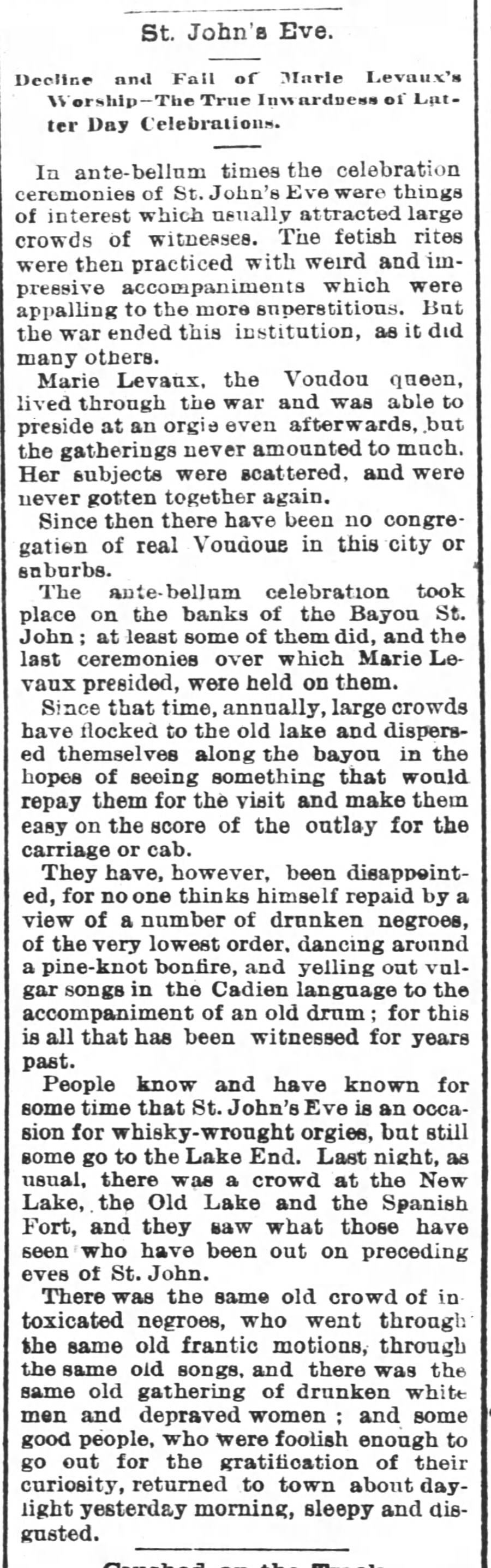
In celebration of St. John’s Eve (June 23), the most sacred holiday in the Voodoo tradition, I’m reflecting on what I’ve learned, what I’ve read, and what I think about myself now. This is an effort to sort through what I’ve learned for my own reference later. It will also change as I learn more. I also published a video with more information about St. John’s Eve and why I think New Orleans is known for Voodoo as of now.
A Comparative Analysis of Voodoo
Because Voodoo has been an oral tradition for a long time and because there are many sects, there are contradictions in the information from researchers and worshipers. The speakers in our classes did not always agree on the facts. The three main sources I’m relying on for this comparison are Priest Robi Gilmore who spoke to our class, The Magic of Marie Laveau: Embracing the Spiritual Legacy of the Voodoo Queen of New Orleans by Denise Alvarado, and The Voodoo Encyclopedia by Jeffrey E. Anderson.
In general, Voodoo is a monotheistic religion that originated in Africa more than 5,000 years ago. It has spread across the world, largely due to the Transatlantic Slave Trade. Enslaved Africans brought their religious traditions to the Caribbean and North America, where they evolved. Religious ceremonies and rituals are largely secret (speakers in my class would not share some information because of this), but some public ceremonies have been performed historically and still occur. In New Orleans, the Voodoo tradition overlaps with Roman Catholicism due to colonialism and restrictions on religious freedom. The religion of Voodoo was never outlawed, but many of its components — gathering, drums, dancing, fortune telling, herbal medicine — were outlawed at various points.
Lwa/Orisha are lesser beings in Voodoo similar to the saints in Catholicism. The name used depends on where you are in the world and what sect you observe. They are more than human but less than God, but closest to God. According to the speakers in my class, the order of prayer is to the living, the ancestors, the Lwa/Orisha, then to God.
Voodoo v. Hoodoo
Priest Robi, shared that there are still no accurate portrayals of his religion in media or books. He also said that the closest depiction is The Skeleton Key, a 2005 movie starring Kate Hudson that is largely about hoodoo. I rewatched it, and there is a scene where one of the characters explains the difference between Voodoo and hoodoo, as I understood Priest Robi, plainly and accurately — Voodoo is a religion and hoodoo is folk magic. The Voodoo Encyclopedia also has this explanation as the most accepted and repeated by scholars.
But that explanation conflicts with Denise Alvarado’s explanation in her book The Magic of Marie Laveau: Embracing the Spiritual Legacy of the Voodoo Queen of New Orleans. Alvarado, who is from New Orleans and was raised in the Marie Laveau tradition, explains that up to a certain point, the terms Voodoo and hoodoo referred to the same practices.
“There are a few theories, mostly by white authors who posit African Americans mistakenly began calling Hoodoo Voudou or vice versa. Others say it was white folks who began calling Voudou Hoodoo or vice versa. I truly believe this is not an issue to Marie Laveau or her followers, as she clearly engaged in Voudou rituals, magick, and gris gris and did not develop illusory categories to define what she was doing. New Orleans practitioners follow suit, rarely arguing this point amongst themselves as we understand how the various aspects of the tradition originated in different regions of Africa and came together in a beautiful, hybridized blend,” Alvarado wrote (p. 49).
She goes on to explain that hoodoo is not embraced by all who observe the Voodoo tradition. In The Voodoo Encyclopedia, Jeffrey E. Anderson explains, “Historically, however, practitioners of what modern historians consider to be Voodoo referred to the faith as hoodoo, using the term Voodoo to designate its practitioners.” Priest Robi shared that the noun for practitioners is voudouizant, but they do not practice; they worship. The uninitiated can be said to “practice” voodoo.
Bayou St. John
In the video “Was Marie Laveau a Voodoo Queen? (Legend v. Reality),” Priest Robi explains that Bayou St. John is where salt and fresh water meet. The two deities of these waters (Yemaja and Oshun) also meet in New Orleans, so Bayou St. John is also integral to the history of New Orleans as a cradle for the religion of Voodoo. Worshipers come from around the world to the sacred location of Bayou St. John. In her book, Alvarado agrees that Bayou St. John is sacred.
“Bayou St. John was one of the spots where Marie Laveau held her annual St. John’s Eve ceremony; but, that’s not the only thing it is known for. One belief tied to the Laveau legend holds that if a person has been crossed, they can remove the conjure by submerging themselves in the spot where Marie Laveau II reportedly drowned. Another bit of lore is the Wishing Spot located on the lakeside of Bayou St. John at the intersection of DeSaix Blvd. There was a hollow tree trunk that functioned like a wishing well where people tossed coins and dollar bills and burned candles in the hopes their wishes would be answered. In another hallowed-out tree in Congo Square referred to as the Wishing Tree, Marie was known for leaving plates of jambalaya and money for the needy after her public dances held there.” Alvarado writes (p. 52).
In The Voodoo Encyclopedia, it’s spelled Bayou St. Jean. Jonathan Foster explains:
“Bayou St. Jean played a significant role in the practice of Voodoo in 19th-century New Orleans. The bayou assumed great importance in the ceremonies of famed priestess Marie Laveau and her supposed daughter Marie the Second. The elder Marie often bought herbs and other supplies needed for rituals from the Native Americans who resided around the bayou. The bayou also served as a favored location for Voodoo ceremonies following the prohibition of such activities at Congo Square. The banks of Bayou St. Jean thus became home to various gatherings aimed at health, good luck, and celebration. These gatherings varied greatly in size and activity, and often included large bonfires, spirited dance, loud music, and feasts. The largest annual ceremony took place on St. John’s Eve (June 23) near the Lake Ponchartrain mouth of the bayou. By the last decades of the century, the St. John’s Eve ceremony sometimes attracted thousands of interested onlookers.”
Catholic Voodoo
In class, we also learned about the hierarchy of spirits and ancestors in the pantheon of Vodou, all providing intercessions on behalf of olodumare, the one creator. Olodumare loosely translates to the owner of the heavens. The ancestors and spirit world are necessary to ask god for help. Alvarado goes into some detail about rituals for the spirits and ancestors in her book, particularly for Marie Laveau.
In The Voodoo Encyclopedia, Dr. Kodi Roberts explains Catholicism and Vodou/Voodoo on pages 46-48, but the word olodumare is not used. Instead, he uses bondye or “the good lord”. Carolyn Morrow Long agrees with this term in A New Orleans Voudou Priestess.
“The saints of New Orleans Voodoo are frequently thought to derive their power and purpose from things that happened to them before their corporeal deaths. It is upon dying that they take on the miraculous powers that make them a help to the living who call on them for assistance with their problems.” p. 47
The similarities between the mystic practices I learned in Catholicism and the demonized rituals of Voodoo are striking — praying novenas and rosaries for intercessions, lighting candles and incense, ceremonies with emotional music, ritualized sacrifice for penance like fasting. It’s easy to understand why enslaved people used the symbolism of Catholicism in their own spiritual practices when they were forced to worship a foreign god and hide their own spirituality.
Voodoo Dolls
One of the myths Priest Robi corrected is the story of Voodoo dolls. He explained that performing magic with dolls is actually a European magical tradition called poppets. In the Voodoo tradition, similar dolls are created to represent people. The purpose of these dolls was more akin to record keeping for medicine doctors, however, as so many people of African descent were prevented from learning to read or write. They used the dolls to note injuries or maladies and treatments. Perhaps the Europeans saw this tradition, recognized its similarity to their own folk magic tradition, and made an assumption.
This explanation does not appear in Alvarado’s book. In The Voodoo Encyclopedia, Anderson confirms Priest Robi’s association of the dolls with European traditions, but he does not mention the medical record-keeping.
“First, the use of dolls is by no means unique to religions of Africa and the African diaspora. Similar items appear in European accounts of witchcraft as well. Some authors have even argued that Voodoo dolls were never part of the belief systems of Haiti and the Mississippi Valley. At any rate, dolls are by no means a central feature in the beliefs of Vodou or Voodoo. The mythology of the Voodoo dolls is bound to the uninformed belief that the faiths they are supposed represent are little more than sorcery designed to hard enemies rather than full-fledged religions with their own pantheon of deities and religious ceremonies.”
Marie Laveau
Marie Laveau is the patron saint of New Orleans Voodoo, according to many. She has been elevated by some to a Lwa. There are many mysteries about her life. Some of the literature and what I learned in class are contradictory. For instance, it’s pretty well established that she was born in New Orleans, according to the academics. This is based on a baptismal record that was discovered in 2001.

It’s also accepted that she has no living descendants based on the archival evidence. But those who know they are her descendants shared with my teacher, Benita “Mama Nita” Scott, that she was born in Haiti and immigrated to New Orleans when she was 6-8 years old. An old legend about Marie is that she knew Voodoo because she was Haitian, but the discovered baptismal record seemingly disproved that.
It’s also widely accepted that she was illiterate. This is because we have found no records of her writing (such as letters or diaries or prayers or cures), she claimed before notaries that she was illiterate, and she signed with an X when necessary. But Mama Nita said this is also untrue. Her descendants said she was taught by Père Antoine at St. Louis Cathedral in secret. Père Antoine died in 1829, when Marie was 28 years old.
We have a record of her first marriage to Jacques Paris in 1819 by Père Antoine, but we have no record of her second marriage to Christophe Glapion. We know she died on June 15, 1881, as her death was reported across the country. She is interred in St. Louis No. 1 as Dame Christophe Glapion, confirmed by the archival evidence. However, some still insist she was actually buried in St. Louis No. 2 to keep the location of her tomb secret from the public.
Conclusion
It’s always struck me as odd that Europeans would qualify the Voodoo religion as both superstition and evil. If it was just rudimentary folk practices with no meaning, why were they so scared of it? One of the points of The Skeleton Key is that you have to believe for the hoodoo to work. It seems to me that the Europeans also believed in the power of Voodoo and hoodoo, the power of those they tried to subjugate, and labeled it demonic.
Three Hundred Years of New Orleans Voodoo
Timeline (Red is a law, italics is a first hand account)
1719 First enslaved people are brought to New Orleans
1723 Capuchin friars arrive
1724 Code Noir implemented, requiring Sundays off for enslaved people
1718-1734 The earliest reference to Congo Square occurs in Antoine-Simon Le Page du Pratz’s Histoire de la Louisiane, a memoir of the nearly two decades he spent in Louisiana between 1718 and 1734
1727 Ursuline nuns arrive in the colony. New Orleans was unique in that the first missionaries were women here to educate women.
1736 Marguerite Semard, Marie Laveau’s great-grandmother, is born in an unknown location. She was enslaved.
1754 Catherine Henry, Marie’s grandmother, is born enslaved
1772 Marguerite Henry, Marie’s mother, is born enslaved
1762ish Louisiana becomes Spanish
1786 Miró outlaws gatherings of enslaved Africans in the Bando de Buen Gobierno (Edict for Good Government) https://www.nps.gov/ethnography/aah/aaheritage/frenchama.htm
1788 An amendment to the Code Noir requires tignon for women of African descent (Sisters of the Holy Family and the Veil of Race p. 200)
1790 Marguerite Henry, Marie’s mother, is granted freedom at age 18.
1795 Catherine Henry, Marie Laveau’s grandmother purchases her freedom at age 42.
1801 Marie Laveau is born free.
1803 The Republic of Haiti is established after the successful Haitian Revolution.
1803 The Louisiana Purchase makes New Orleans American.
1804 Louisiana becomes the first place requiring a license for pharmacy.
1804 Congo square becomes open land (not just swamps and woods).
1808 People of African descent are required to add homme or femme de couleur libre (fmc or fwc) on all business or legal documents.
1808 The United States bans the importation of enslaved Africans.
1811 German Coast uprising.
1812 Congo Square becomes a public square Place Publique.
1817 Ordinance forbidding enslaved people to gather except on Sundays in Congo Square then called Place Publique.
1819 First hand account of Sunday at Congo Square from Benjamin Latrobe in his journal https://smarthistory.org/congo-square-new-orleans/
1835 Sunday afternoon music and dancing outlawed in Congo Square, effectively banning to Voodoo traditions.
1845 People of African descent allowed back in Congo Square with musical instruments.
1848 Description in Times Picayune of Congo Square.
1850 Oldest reference to voudou in newspaper.
1856 People of African descent couldn’t play horns or drums in the city — rituals moved to the lake.
1862 New Orleans falls to the Union in the Civil War.
1863 Oldest reference to voodoo in newspaper.
1869 July 5 first newspaper account of St. John’s Eve celebration (Long, p. 122)
1869 Possession reported in the newspaper
1872 Last report of Marie Laveau at a St. John’s Eve ceremony in the newspaper (Long p. 126)
1877-1888 Lafcadio Hearn “invents” New Orleans
1880 George Washington Cable publishes “The Grandissimes” (character is thought to be based on Marie and he claimed to visit her shortly before her death).
1881 Marie Laveau dies
1885 Last of the Voudous by Lafcadio Hearn published in Harper’s Weekly
1887 Congo dance at West End advertised
1887 State law forbidding medicine without a license (Long, p. 128)
1890 Jazz begins forming
1897 New Orleans ordinance against fortune telling (Long, p. 128)
1897-1917 Storyville
1945 Lyle Saxon publishes “Gumbo Ya-Ya”.
1956 Robert Tallant publishes “The Voodoo Queen”.
1973 Cynthia Himel was writing a thesis at LSUNO; St. John’s Eve event at Edna and Harry Freiberg’s home on Bayou St. John. The Freibergs hosted an annual St. John’s Eve event from at least 1966-1975.
1977 Sallie Ann Glassman begins practicing Voodoo in New Orleans (self-reported).
1990 First ad for Voodoo ceremony by Sallie Ann Glassman.
2005 Skeleton Key movie
YouTube videos of the Rituals in New Orleans:
2007 https://youtu.be/PJPx9xhplYw?si=irQu4u82jYe6R0-u
2008 https://youtu.be/bZUYhbgGhCU?si=ynsD0qhQgNkNsVHS
2011 https://youtu.be/RhwWvGYGAXo?si=pYBdiDFoBUx7jUd8
2013 https://youtu.be/iMJ86oYGlX0?si=oVOZns2a4UVMtzkZ
2014 https://youtu.be/zWYqVsZlHRY?si=QpRL9qnSpK_V0FKE
2014 https://youtu.be/2zRvxpxVMI8?si=loltuoOJjfWff2XM
2015? https://youtu.be/ZePgj6rLV5k?si=qiCcnfMCCE1zn9GX
2017 https://youtube.com/shorts/oGU_g_KJUmE?si=LgnY4OGEXh5B9_6i
2018 https://youtu.be/sFZQhD79rYs?si=KJDDH-yaaAZyrR_z
2021 https://youtu.be/Zf1-wgssagQ?si=YvywswtlO3pvGapy

Sources
- Alvarado, Denise. The Magic of Marie Laveau: Embracing the Spiritual Legacy of the Voodoo Queen of New Orleans Weiser Books, February 1, 2020.
- Long, Carolyn Morrow. A New Orleans Voudou Queen: The Legend and Reality of Marie Laveau University Press of Florida, October 7, 2007.
- Roberts, Kodi, ”The Secret and Irreligious Doctrines of Voodooism: Institutionalization versus Cultural Stigma in New Orleans Civil Court.” Journal of Church and State, Volume 60, Issue 4, Autumn 2018, Pages 661–680, https://doi.org/10.1093/jcs/csy004
- Scott, Benita “Mama Nita.” “Voodoo Practices with Priest Robi and Dr. Crow.” Guest speakers Robi Gilmore and Andrew Wiseman (Dr. Crow). The History of New Orleans Vooodoo. Loyola University of New Orleans, New Orleans, LA, March 21, 2024.
- Wiseman, Andrew (Dr. Crow). “Voodoo Tour by Dr. Crow.” New Orleans Historic Voodoo Museum, New Orleans, LA, Sunday, April 7, 2024.
- “New Orleans Vooodoo from the Inside” directed by David M. Jones, DMJ Productions, November 1, 1996. M U. September 30, 2022. https://youtu.be/oQV8CgvYssU?si=fo9dfTmBUz8KVEuw
- “Was Marie Laveau a Voodoo Queen? (Legend v. Reality)” Free Tours by Foot New Orleans. June 11, 2021. https://youtu.be/6_a_6SsrK_o?si=ErpGgCttZG8JMwva
- Asher, Kat. “Voodoo Priestess Marie Laveau Created New Orleans Midsummer Festival” June 23, 2017. American South: A Smithsonian Magazine Special Report. https://www.smithsonianmag.com/smart-news/voodoo-priestess-marie-laveau-created-new-orleans-midsummer-festival-180963750
- Calogne, Kristine. “Expert Uncovers Birth Record of Voodoo Queen Marie Laveau.” LSU Press Release, March 28, 2002. https://www.newswise.com/articles/expert-uncovers-birth-record-of-voodoo-queen-marie-laveau
- Anderson, Jeffrey E. “Dolls.”The Voodoo Encyclopedia: Magic, Ritual and Religion, edited by Jeffrey E. Anderson, ABC-CLIO, LLC, Santa Barbara, California, 2015, pp. 78-79.
- Anderson, Jeffrey E. “Saint John’s Eve.”The Voodoo Encyclopedia: Magic, Ritual and Religion, edited by Jeffrey E. Anderson, ABC-CLIO, LLC, Santa Barbara, California, 2015, pp. 253-254.
- Anderson, Jeffrey E. “Voodoo in the Mississippi Valley.”The Voodoo Encyclopedia: Magic, Ritual and Religion, edited by Jeffrey E. Anderson, ABC-CLIO, LLC, Santa Barbara, California, 2015, pp. 306-310.
- Foster, Jonathan. “Bayou St. Jean.” The Voodoo Encyclopedia: Magic, Ritual and Religion, edited by Jeffrey E. Anderson, ABC-CLIO, LLC, Santa Barbara, California, 2015, pp. 20-21.
- Long, Carolyn Morrow. “Jean Montanée.” The Voodoo Encyclopedia: Magic, Ritual and Religion, edited by Jeffrey E. Anderson, ABC-CLIP, LLC, Santa Barbara, California, 2015, pp. 190-191.
- Roberts, Kodi. “Catholicism and Vodou/Voodoo.” The Voodoo Encyclopedia: Magic, Ritual and Religion, edited by Jeffrey E. Anderson, ABC-CLIP, LLC, Santa Barbara, California, 2015, pp. 46-48.
- Hearn, Lafcadio. Inventing New Orleans. University of Mississippi Press, Jackson, Mississippi, 2001.
- O’Neill Schmitt, Rory. New Orleans Vooodoo: A Cultural History. The History Press, Charleston, South Carolina, 2019.
- Fandrich, Ina J. “The Birth of New Orleans’ Voodoo Queen: A Long-Held Mystery Resolved.” Louisiana History: The Journal of the Louisiana Historical Association, vol. 46, no. 3, 2005, pp. 293–309. JSTOR, http://www.jstor.org/stable/4234122. Accessed 8 June 2024.
- Olivarius, Kathryn. “Death, Data, and Denial in Antebellum New Orleans.” Harvard Library Bulletin. https://harvardlibrarybulletin.org/death-data-and-denial-antebellum-new-orleans
- Neidenbach, Elizabeth Clark. “Free People of Color: Free people of color constituted a diverse segment of Louisiana’s population and included people that were born free or enslaved, were of African or mixed racial ancestry, and were French- or English-speaking.” 64 Parishes, Louisiana Endowment for the Humanities, April 28, 2011. https://64parishes.org/entry/free-people-of-color
- Clark, Emily, and Virginia Meacham Gould. “The Feminine Face of Afro-Catholicism in New Orleans, 1727-1852.” The William and Mary Quarterly, vol. 59, no. 2, 2002, pp. 409–48. JSTOR, https://doi.org/10.2307/3491743. Accessed 9 Feb. 2024.
- Advocate staff report. “300 unique New Orleans moments: Records of free people of color in Louisiana date back to 1722.” New Orleans Advocate, The (LA), sec. Tricentennial, 6 Oct. 2017. NewsBank: America’s News – Historical and Current, https://infoweb.newsbank.com/apps/news/openurl?ctx_ver=z39.88-2004&rft_id=info%3Asid/infoweb.newsbank.com&svc_dat=AMNEWS&req_dat=0D1CD317F8F22780&rft_val_format=info%3Aofi/fmt%3Akev%3Amtx%3Actx&rft_dat=document_id%3Anews/1676653A10837290. Accessed 14 June 2024.
- Ulentin, Anne, “Free women of color and slaveholding in New Orleans, 1810-1830” (2007). LSU Master’s Theses. 3013.
https://repository.lsu.edu/gradschool_theses/3013
Further Research (for me)
- Roberts, Kodi A. Voodoo and Power: The Politics of Religion in New Orleans, 1881–1940 LSU Press, Baton Rouge, LA, November 13, 2015.
- Anderson, Jeffrey E. Voodoo: An African American Religion LSU Press, Baton Rouge, LA, March 20, 2024.
- Additional Voodoo tour (seeking recommendations)

Leave a Reply