
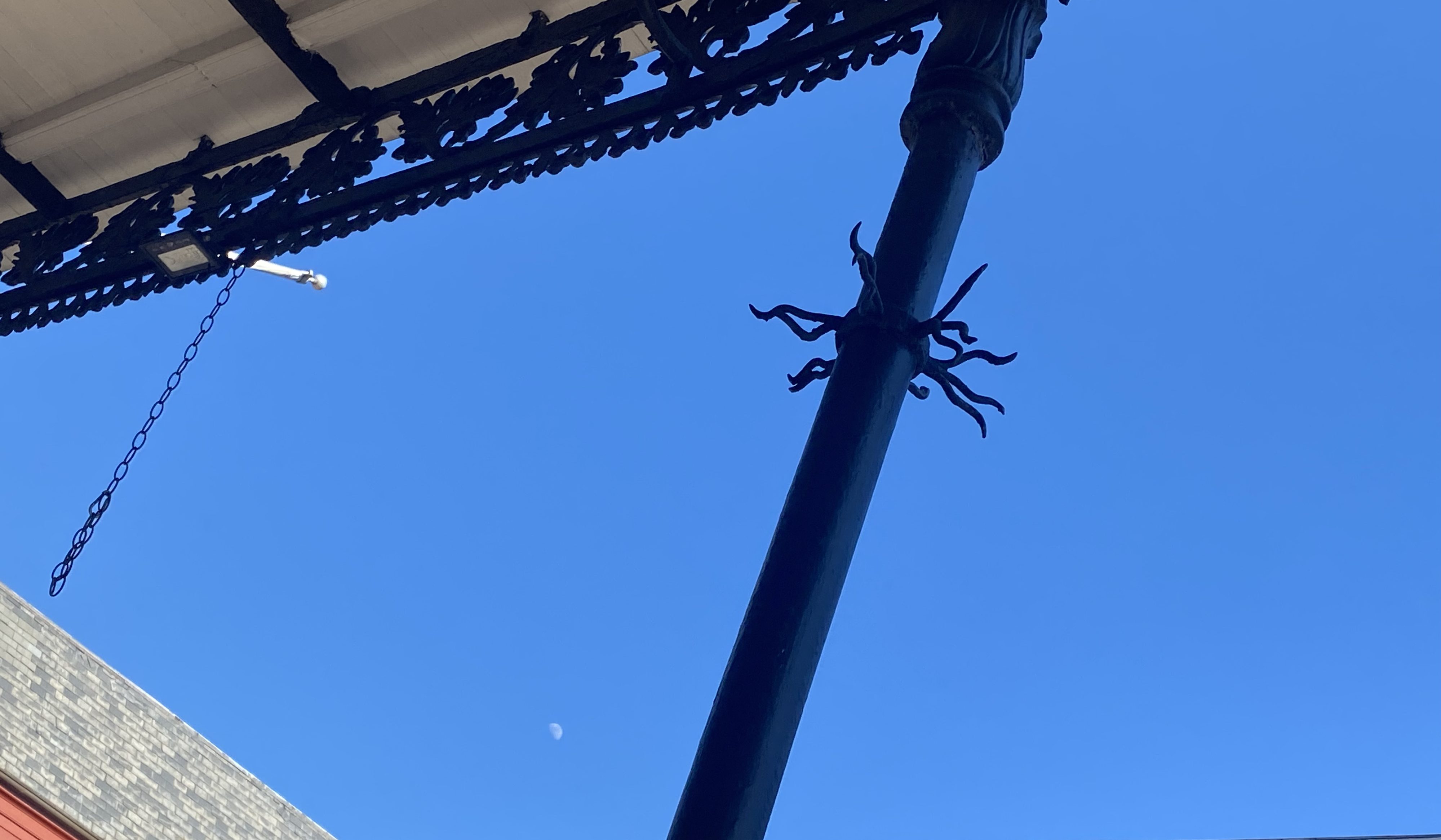
Go up a Romeo but come down a Juliet…?
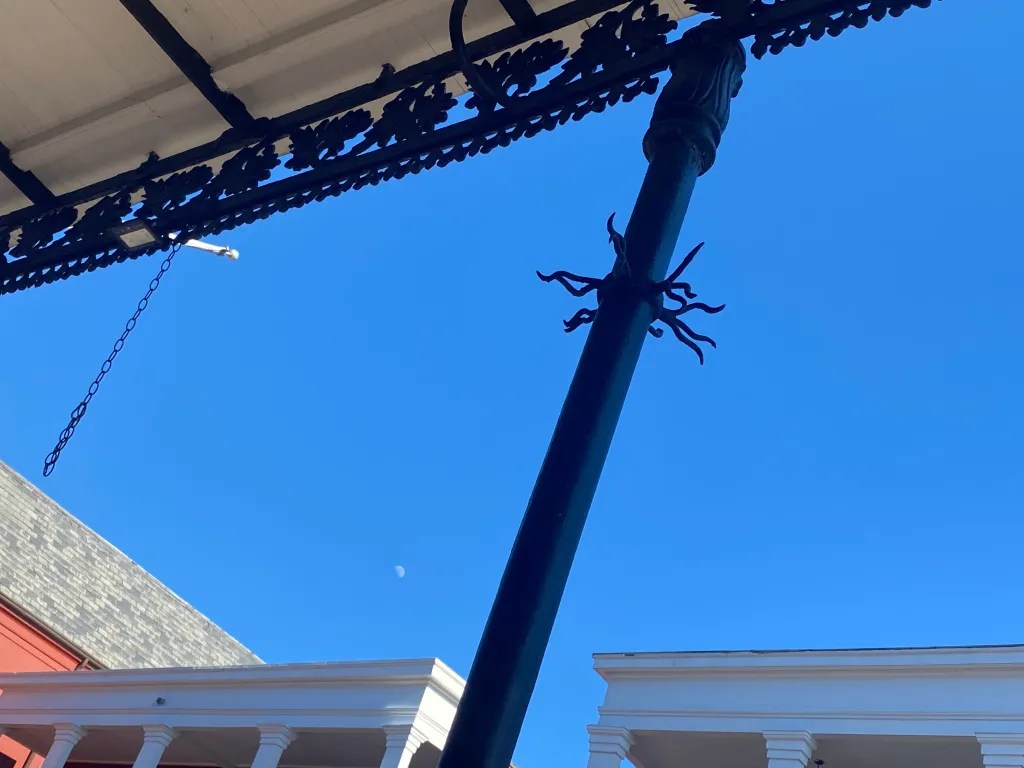
Have you noticed this architectural oddity in the French Quarter on iron columns — the Romeo Spikes, sometimes Romeo Prongs or Romeo Catchers?
The legend is that the vicious-looking spikes were added to the gallery columns by homeowners to keep prospective suitors away from their daughters. Some tours will continue with a ghost story about a young man who was castrated as a result of an attempt to best the spikes. So, you can tell which families had daughters by which homes have spikes. Below is a map of the spikes I’ve located in the French Quarter, but I’d love to add any others you’ve found too!
While I was researching another unbelievable tale, I stumbled upon a correction of the Romeo Spikes myth claiming that the spikes are actually hostile architecture meant to keep birds away. But there is no place for a bird to nest on the posts without the spikes. Adding the spikes only seems to create a comfy place for small birds, not deter them.



And making this realization while taking photos of the spikes led me to find other spikes nearby on fences. These spikes are very similar to spikes on fences in Charleston, South Carolina. I found some information about those fences: they were prototypes for barbed wire and the homeowners installed them after reports of an attempted revolt of enslaved people…


This seems like a much more likely explanation for the Romeo spikes as well, but still I could not find anything about them outside of blogs about ghosts. I realized that the Romeo spikes were added to the columns, not a part of the original design. That led me to realize that the spikes look extremely similar to iron collars that enslavers used as punishment.

Digging Deeper on Romeo Spikes
I messaged the tour guide who was quoted to ask for a source for the information about birds, and I will update this if I hear back. I also started reaching out to knowledgable tour guides to see if they had any other information about the spikes. Eventually, I found Craig Ernst, who is a realtor in New Orleans and a volunteer tour guide with Friends of the Cabildo, one of the most respected tour guiding programs in the city. He calls himself a New Orleans history and architecture nerd. He not only responded and responded quickly, he gave me additional information!
“I think the stories about the ‘Romeo spikes’ are just romanticized tales about what were, essentially, just another form of intruder deterrent,” he wrote.
“Like you, I found the information about the large cheval-de-frise emplacements in Charleston. The rolls of spikes on top of some fences and gateways in the Quarter are just smaller versions of that. (Incidentally, these were originally designed as medieval protections against cavalry charges. The French translates to ‘Frisian horse’ or horseman of Frisia — a part of the Netherlands — were considered especially fierce, apparently. Similarly, the gardes-de-frise, which are the ironwork panels fashioned with different types of spikes on top and which are placed to divide balconies/galleries/verandas, or at the ends of the same, are a similar form of deterrent. I think the origin is as simple as that.”

He continued.
”Your thought about the similarity of the Romeo spikes to some of the slave collars is interesting. I’m not sure there is any direct connection (if you find out otherwise, please let me know), but it’s possible that the design of one may have inspired the design of the other.”

I found many references in the newspapers to iron collars in advertisements for people who were wearing them when they ran away from enslavement. But I have not yet found any reference to the spikes on columns in the newspaper. I found a photo showing that at least one set of Romeo spikes was added between 1965 and 1975. But many other spikes appear in all images of the buildings available.
Do you have any more information about the Romeo spikes and their origins? I’d love to hear from you!
Also, check out my instagram to see more photos of Romeo spikes in the French Quarter @from_the_deep_gifts
Addresses with Romeo spikes now and if they had daughters (in progress):
839 Chartres [old address 217 Chartres] built in 1820s, cast iron gallery added later (sometime before 1876)
1225 Chartres [old address 306 Chartres] built in 1830, cast iron gallery added sometime later; sold in 1833 (Manuel Julián de Lizardi who had no children1), 1849 (Canon to son, only heir2), 1858 (Canon to Pierre Hoa who had one daughter)
700-708 Royal built in 1840; sold in 1866 from the LaBranche family who had at least one daughter who lived to adulthood3 4
721-727 Royal built in 1840; sold to Marie de Roffignac in 1848 from her brothers; Marie had one son and one grandson5
736 Royal built in the late 1830s by the wardens of St. Louis Cathedral; purchased by George H. Dunbar in 1880 who had several daughters with several wives6
900 Royal built 1838 for Louis Christian Miltenberger with cast iron galleries added in 18587; Christian died in 18298 but his wife Marie Aimee died in 1858; she gave the property to her son Gustave in 18559 who had one daughter; Gustave kept the property until 1868 when it passed to his brother Aristide (one daughter) and son Charles (one son who died in Paris during World War I)10; it stayed in the Miltenberger family until 1877 when it was sold in a sheriff’s sale
1014 Royal
1018 Royal
641 Barracks built in 1834; wrap around balcony is original, but the posts with Romeo spikes were added sometime between 1989 and 200711
210 Bourbon built in 1840; had a cast iron covered gallery in the 19th century that was removed and then restored in 198112
640 Bourbon
1203 Bourbon
500 Dauphine [old address 105 St. Louis] built in 1999; this was a Texaco station built in 1935 prior to the current building13; in 1896 it was a store according to the Sanborn insurance map14
740 Dauphine [old address 108 St. Ann] building is a Creole cottage from the 19th century, but the second story was added in 192015
1031 Dauphine [old address 253 Dauphine] built in 1840; purchased by Louis Le Carpentier in 1841 who had one daughter
901 Governor Nicholls [old address 121 Hospital?] built in 1840; cast iron gallery added between 1876 and 1896;
425 Burgundy built in 1840; cast iron gallery added later16
811 Burgundy built in 1880; the gallery is original to the building but the Romeo spikes were added around 2008 based on Google Maps archived images17
Sources:
- Roach, Madeleine R., “Don’t Be Myth-taken: The Perpetuation of Historical Myths in New Orleans Tourism” (2021). University of New Orleans Theses and Dissertations. 2902. https://scholarworks.uno.edu/td/2902
- “French Quarter Romeo Spikes” by Royal Tours New Orleans. October 29, 2020. https://www.royaltoursneworleans.com/french-quarter-romeo-spikes“https://www.royaltoursneworleans.com/french-quarter-romeo-spikes
- “Walls and Fences in Antebellum Charleston” by Charleston Seen Blog. July 18, 2014. https://charlestonseen.wordpress.com/2014/07/18/walls-and-fences-in-antebellum-charleston/
- Salvucci, Linda K., and Richard J. Salvucci. “The Lizardi Brothers: A Mexican Family Business and the Expansion of New Orleans, 1825-1846.” The Journal of Southern History, vol. 82, no. 4, 2016, pp. 759–88. JSTOR, http://www.jstor.org/stable/44784503. Accessed 3 July 2024. ↩︎
- https://www.hnoc.org/vcs/property_info.php?lot=22794 ↩︎
- https://www.ancestry.com/genealogy/records/jean-baptiste-labranche-24-2nc32jn ↩︎
- https://gw.geneanet.org/sparklynn?n=trepagnier&oc=&p=aimee ↩︎
- https://gw.geneanet.org/pierfit?lang=en&n=grehan&oc=0&p=paul+joseph+arthur ↩︎
- https://ancestors.pitard.net/getperson.php?personID=I9611&tree=1sttree ↩︎
- https://www.hnoc.org/vcs/property_info.php?lot=18561 ↩︎
- https://www.findagrave.com/memorial/157894498/louis_christian_miltenberger ↩︎
- https://www.hnoc.org/vcs/property_info.php?lot=18561 ↩︎
- https://www.findagrave.com/memorial/21233872/william_fernand_miltenberger ↩︎
- https://www.hnoc.org/vcs/property_info.php?lot=22824 ↩︎
- https://www.hnoc.org/vcs/property_info.php?lot=11329 ↩︎
- https://www.hnoc.org/vcs/property_info.php?lot=18709 ↩︎
- https://www.loc.gov/resource/g4014nm.g03376190801/?sp=1&r=0.611,0.706,0.325,0.169,0 ↩︎
- https://www.hnoc.org/vcs/property_info.php?lot=18772 ↩︎
- https://www.hnoc.org/vcs/property_info.php?lot=11567 ↩︎
- https://www.hnoc.org/vcs/property_info.php?lot=19081 ↩︎

Leave a Reply