
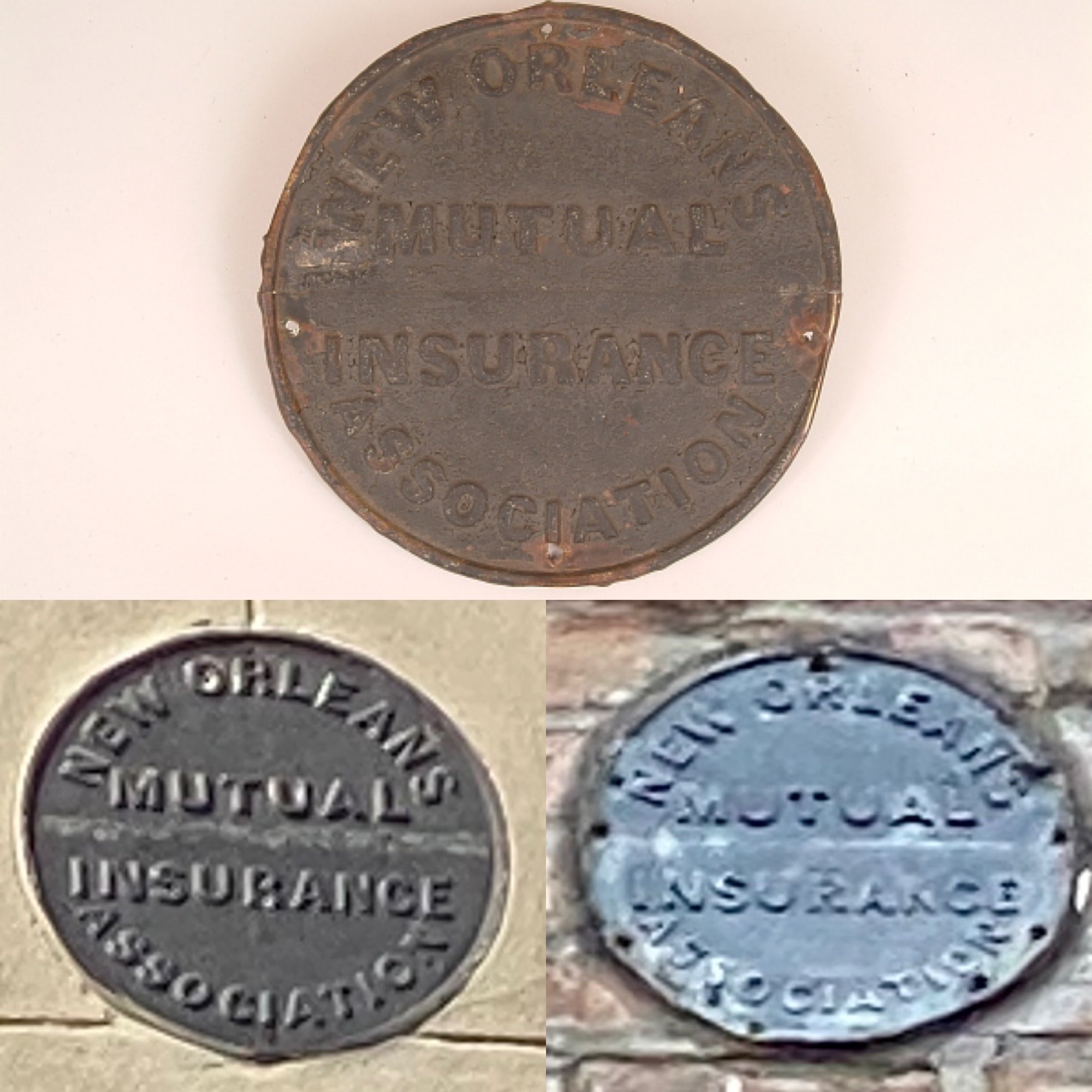
A lingering detail from the 19th century
While preparing to lead my own tours, I went on a respected French Quarter tour. At the end, the guide showed us a fire mark on a building and explained that these noted which buildings had fire insurance and which company would come to help in the event of a fire. They said there were only five such markers left in the French Quarter because they had been removed and melted to make bullets during the Civil War as they were made from lead. They also promised to buy us a drink if we found the other four. But curiously did not provide any contact information to settle that bet.
Read more: Fire Marks, An Unusual Adventure
Of course, I immediately decided to find the rest of the markers. Not for a beverage but for the knowledge. I wouldn’t let myself Google anything about it until I thought I found them all. The other day, I found a fifth mark and so I started googling. And then I found a sixth one…and a seventh and an eighth…and I keep finding them.


The Truth
I won’t pretend to be a fire mark expert. There are already several blogs debunking the many myths around fire marks around the world, not just in New Orleans. I’ll point you to many articles by Robert M. Shea of the Fire Mark Circle of the Americas for a full detailed history. But a brief explanation is that they originated in England around 1681 after the Great Fire of London in 1666, and there are many examples of different styles and many buildings in several countries that retain their fire marks to this day.

The legend is that the marks indicated the private company that the owner had paid for insurance that the company would help you in the event of a fire and other companies, if they arrived first, would let you burn. This was mostly true in England where they had private companies doing this work. Although the letting you burn part is apparently not true.

Before Fire Insurance
Fire had already destroyed many of the world’s cities, including New Orleans in 1788…and 1794, by the 19th century. They knew how destructive an unchecked fire could be and were not willing to risk letting fires burn.
According to Shea, in at least some documented instances, the fire marks represented the company who would pay the reward to the volunteer brigade who arrived at the fire first to put it out. The building’s owner had purchased insurance through the company, and some of them would guarantee rewards for the fire fighters. In the event of a fire, the first fire brigade to arrive to put out the fire would receive a cash reward for their work.
The Fire Mark and the Antique Trade
If your building didn’t retain a mark to modern times, no problem! They are readily available on eBay for $20. You can find them painted or aged and different varieties to adorn your old building. Or young building.


I also found that the one identical to the one the guide showed me on tour sold at auction recently for an attainable $90.

Perhaps one of the most interesting bits of info I found in my search is that New Orleans Square in Disneyland includes this detail on some of the buildings. There are several blogs explaining what they are by Disney lovers.

None of the examples I’ve matched to the ones I found in the French Quarter have been made of lead so far. Several are confirmed to be from companies that existed only after the Civil War. I think it’s more likely that reasons like time and renovations have removed the fire marks, not the dramatic making of bullets for war.
This adventure was fun even if I have no way of sharing my findings with my guide beyond this blog. Perhaps I will run into them on the tour circuit soon. I am certainly glad to have any additional knowledge about the details of New Orleans.
I also want to hear your stories! Let me know if you’ve found any fire marks that I missed in New Orleans and beyond.
Now, about those Romeo spikes…
Sources
- “New Orleans Mutual Insurance Association Fire Mark” Date made: 1869. Behring Center of the National Museum of American History. Catalog Number: 2005.0233.0477. https://americanhistory.si.edu/collections/nmah_1342267
- “A Short History of Fire Marks, The World’s Hottest Insurance-Related Antiques” by Eric Grundhauser. August 29, 2017. https://www.atlasobscura.com/articles/fire-mark-collectible-insurance-crest
- “Fireman’s Insurance Company Fire Mark” Date made: ca 1875. Behring Center of the National Museum of American History. Catalog Number: 2005.0233.0473 https://americanhistory.si.edu/collections/nmah_1342356
- “American Fire Marks – A Good Story” by Robert M. Shea, CPCU. March 2014. https://firemarkcircle.org/american-fire-marks-a-good-story
- “Fire Marks: Discovering Facts Among Myth” by Robert M. Shea, CPCU. January 12, 2018. https://www.antiquetrader.com/features/fire-marks-discovering-facts-among-myth
- “Myth #146: In early America, firefighters wouldn’t put out a house fire unless the building bore a fire insurance plaque” by History Myths Debunked blog. May 13, 2017. https://historymyths.wordpress.com/tag/fire-marks/
- Fire Mark Gallery from the New York City Fire Museum. https://www.nycfiremuseum.org/fire-marks#:~:text=The%20purpose%20of%20fire%20marks,fire%20marks%20are%20collector%20items.

Leave a Reply