
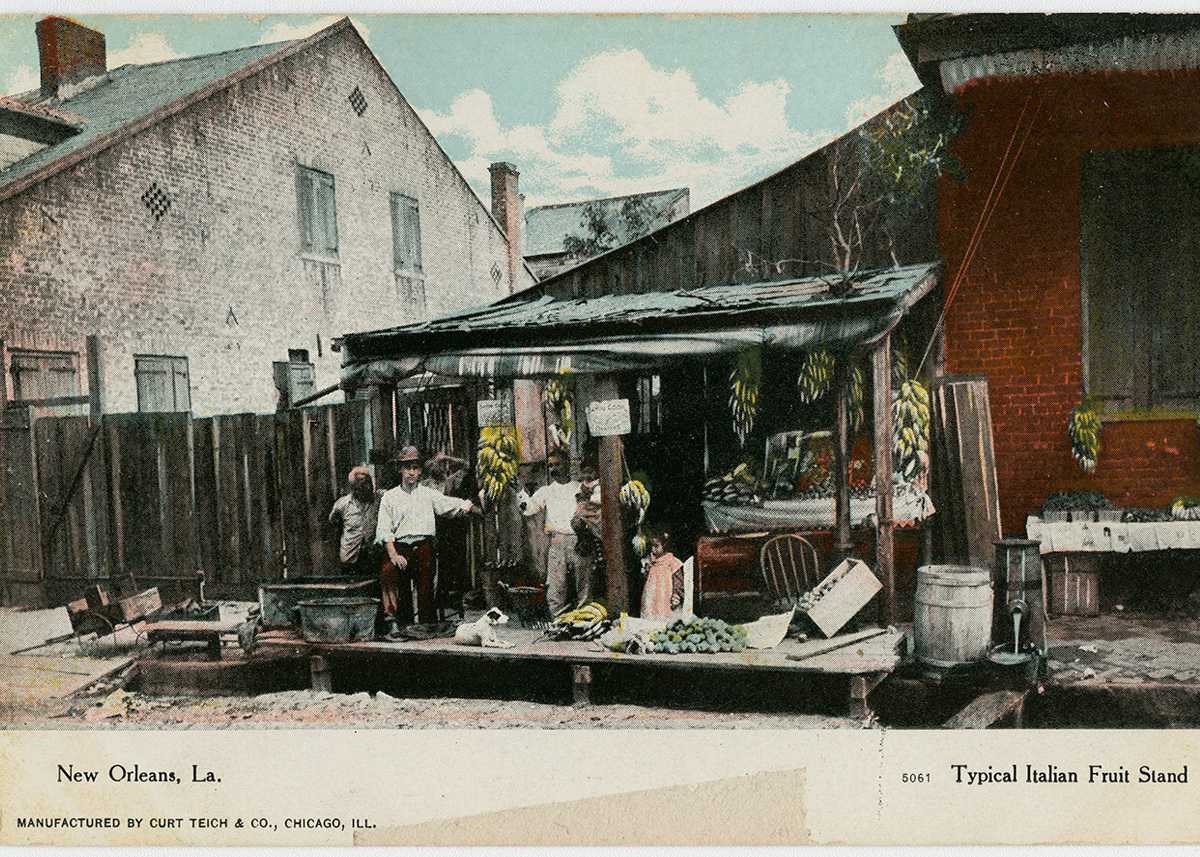

At the end of the 19th century, many immigrants to New Orleans were from Sicily, and parts of the French Quarter became known as Little Italy or Piccolo Palermo. The changing demographics changed the culture of the Crescent City again, adding another layer to the sediment. The primary Italian immigration occurred between 1870-1930, after the Civil War and the unification of Italy, as Sicilians were considered a replacement for cheap labor after slavery was abolished and were fleeing political unrest.
Disclaimer: the Italian cultural heritage of New Orleans is rich and deep and impossible to cover in a blog entry. This is a shallow dive to give context of the time that the shop of The Two Sisters closed. I visited the Italian American Cultural Center in New Orleans to try to round out my knowledge, but I found errors in the information presented there.
Only New York has a higher population of Sicilian-Americans and Sicilian immigrants than New Orleans, according to Wikipedia. This little known fact is part of why the Yat accent of New Orleanians and the thick accent of native New Yorkers are so similar.
In the legend of the Sisters, Emma and Berthe close their shop in 1906 because of the influx of Italians into the French Quarter. The 1910 census showed that the French Quarter was 80 percent citizens of Italian descent, so it is true that Italian Americans took over the neighborhood. [EDIT: see note in the comments with more accurate information.] However, Emma was married to one of the French Quarter Italians. Her husband was Rafael Musso, who went by Ralph. He is buried with them at St. Louis Cemetery No. 3. They had a son together named Edward who became a dentist. Emma’s son died before she did. Ralph’s address was 615 Royal in the 1907 and 1908 City Directories, but Mrs. E. Angaud’s residence is 613 Royal by 1912. Mrs. Henri Parlongue, Emma and Berthe’s mother, lived two blocks away at 808 Royal Street. The notions shop is still listed in the directory at 808 Royal in both 1907 and 1908.
They likely moved or closed the shop of The Two Sisters because of the death of Emile Angaud, who acquired the building in 1886. Emile was Berthe’s father-in-law and he died in 1896 in France, where he had returned seven years before. It took several years to settle his estate. Berthe’s mother-in-law is never listed as the property owner, but she is listed as the resident for several years. The property was transferred into the sister-in-law’s name from Emile’s in the official record. She kept the property until 1925, just before the property transitioned to a cabaret.
Perhaps the sisters’ shop was no longer fashionable with the Creole high society. Perhaps the sister-in-law took the property back to claim her spot at the top of society. Perhaps the sisters just decided to retire. Whatever the cause, it seems unlikely that Italians would have driven out the sisters, who did not seem to care much about cultural differences, and who welcomed an Italian as a husband. But the French Quarter did become Piccolo Palermo for a little while and leave an indelible mark on our city. Time to go have a muffuletta.
- Mardi Gras Memoirs: The Secret Parade
- Red Light Liz and Joe the Whipper
- Cabbage for Money, Black Eyed Peas for Luck
- Two Odd Fellows
- Museum Review: The Germaine Wells Mardi Gras Museum at Arnaud’s


Leave a Reply